
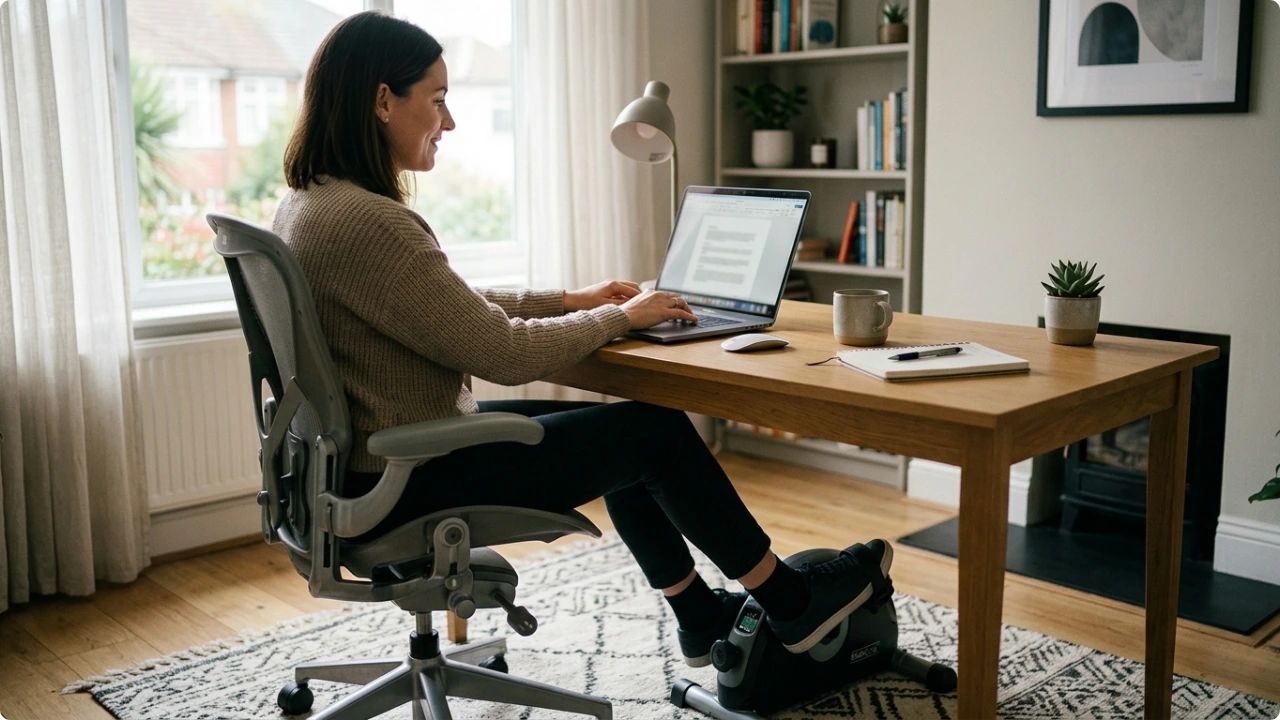
Desk exercise equipment keeps your lower body moving while seated, so you can stave off the stiffness of a long day at the desk. None of it takes up your work surface — it sits under the desk or out of the way until you need it.
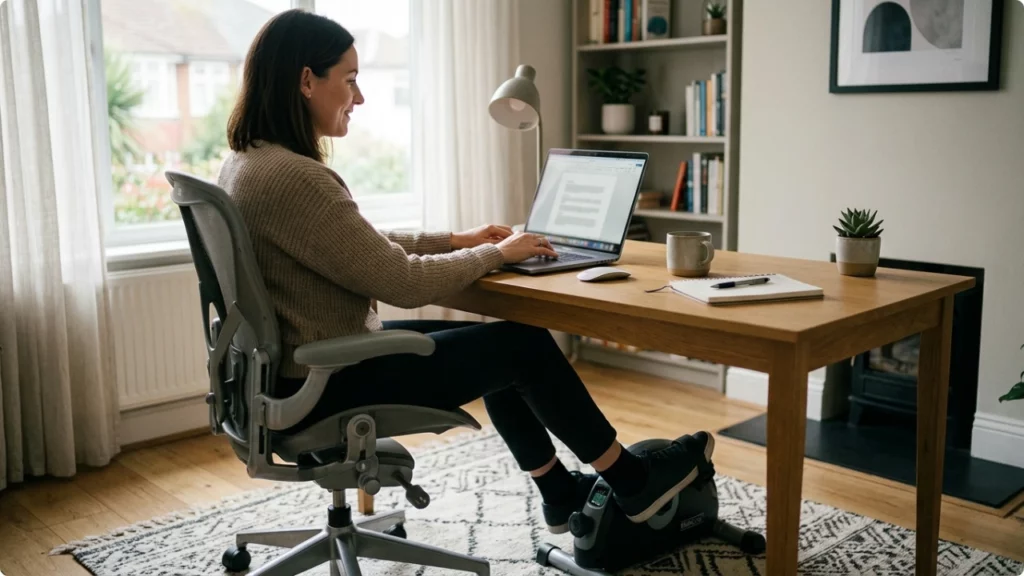
The aim of desk exercise equipment is to keep you moving while you’re sitting. Light enough motions that won’t take your attention away from the work you need to do.
Some can help you move your legs and feet all day, others can be parked in your desk drawer, out your way until you find a few minutes to use them.
There are different types of equipment, none help with fitness, but all should help address the problems you feel creep in from sitting still all day.
5 Types of At-the-Desk Exercise Equipment
The five types are split roughly into kit that adds movement underneath the desk, kit that brings movement into how you sit, and others you reach for between tasks.
Under-desk pedal exercisers
A pedal exerciser is a compact set of pedals that sits in the footwell, so you can turn your legs over steadily while you carry on working. It brings a bit of continuous movement into the part of the day your lower half would otherwise spend completely still.
The resistance is light by design, to enable movement. Despite many of the under-desk bikes having multiple settings, for working at the desk, it’s the lightest tension that works best.
You can maintain the movement for longer without reaching down to change the dial, which is what breaks your focus. Where it will interrupt your day is when it slides on the floor. Some units are more stable and others work best with a mat under them. Particularly on wood floors.
Under-desk ellipticals
An under-desk elliptical works on the same idea but with a longer, smoother stride than a flat pedal, so your legs move through more of their range while you stay seated.
It’s bulkier, and it needs a bit of footwell clearance and the right seat height to feel natural — too high and you’ll push the chair back as you go. It suits you when you’ve the room for it and you’d rather a smoother motion than a tight little pedal stroke.
Pedals and ellipticals are a couple of the best under-desk exercisers that keep your legs and feet moving through the day while you stay seated.
Active sitting stools
An active sitting stool is a perch that tilts and shifts under you, so staying upright takes small, constant adjustments. The movement comes from how you sit — it keeps your core engaged to keep you balanced, instead of resting against a backrest.
Being a stool, there’s obviously no back support, so it’s tiring if you try to use it all day, and it’s meant to alternate with a proper supportive chair rather than replace it.
Twenty to forty minutes at a stretch is plenty — enough to feel the benefit of sitting actively before you settle back into something more supportive. If that appeals, the best ergonomic stool for desk work should support tilting, rather than relying on wheels and swivel to move you while your body doesn’t shift much.
Balance cushions
A balance cushion is an inflatable disc you put on the chair you already have, and it’s the easiest way into active seating without changing your chair at all. Sitting on it, you make small constant adjustments to stay level, so you’re subtly moving instead of frozen in one position.
It isn’t one for all day, though, or the small muscles doing that balancing get tired. Twenty to thirty minutes while you’re on lighter work — reading through email, say — is the sweet spot. After that it earns a second job: flip it behind you and prop it at your lower back as a dynamic lumbar support cushion.
Resistance bands
Resistance bands are the odd one out here — they live in a drawer rather than under the desk, and they bring your upper body into a day that’s otherwise spent fairly still. A few pulls and presses between tasks, and your arms, shoulders and back have done something.
The catch is that they only work when you remember them — there’s nothing continuous about it the way there is with the under-desk kit, and you can’t very well do them when your hands are typing and doing mouse work. A short set between tasks, or before a meeting, is the way to fit these in.
The Dynamic Side of Your Desk Setup
Think of your desk setup as having two halves. One is the stationary side — the chair, the desk height, where the monitor sits, how far you reach for the mouse. Get that wrong and no amount of pedalling fixes it. The other is the moving side: what you do to break up sitting still once everything’s in the right place. The equipment above belongs to that second half.
Before you reach for any of it, it’s worth knowing which half your problem really sits in.
If your setup isn’t sorted yet, start there — a footrest, the right desk height, the mouse pulled in closer to the keyboard. A lot of what gets put down to needing more movement may be a chair positioned too far, short, or high for the desk height. Getting the ergonomically correct desk setup is the cheaper first move, and sometimes the only one you need.
If your setup’s already fine and you just stiffen up over the day, movement is the fix — and the free version costs nothing. A handful of exercises to do at your desk, like seated leg lifts and ankle circles, break up the sitting without buying a thing.
And if you sit well, the basics are right, and you still want more motion in the day than stretching alone gives you — that’s where the desk exercise equipment can have the biggest impact on how you finish your workday.