
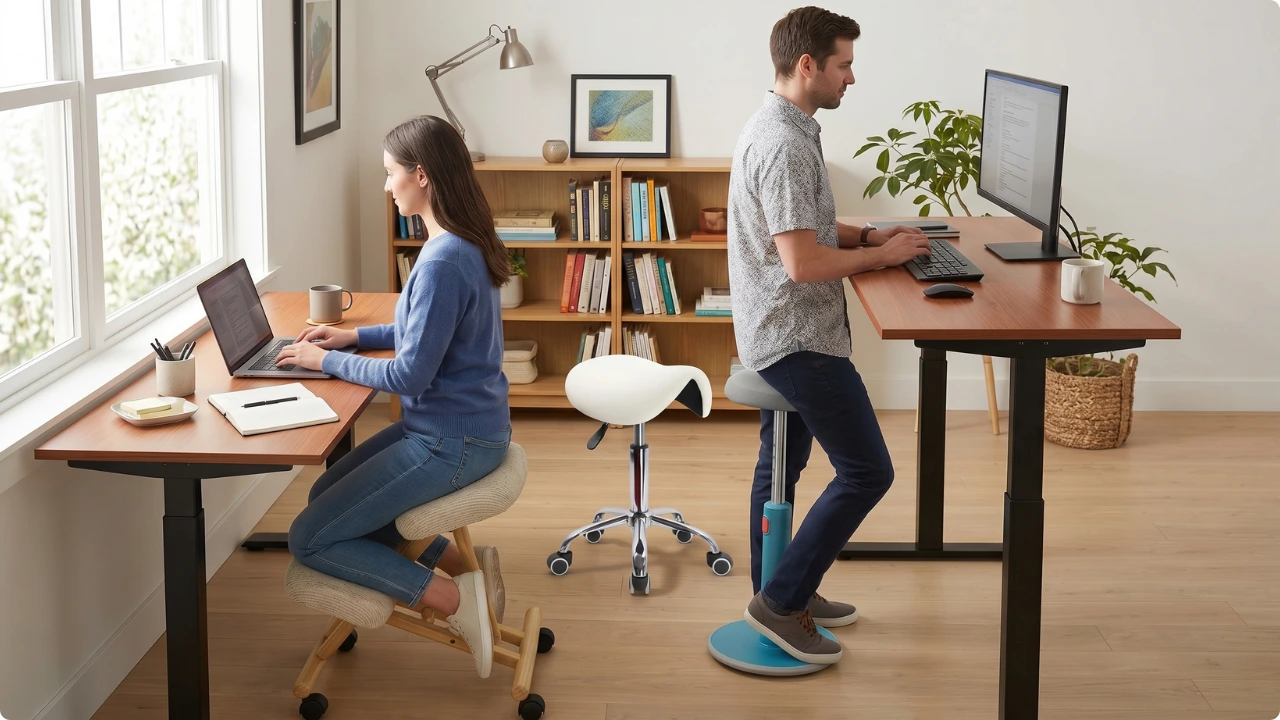
Ergonomic stools aren’t comfier office chairs. They’re built to stop you settling in. Here’s how the three main types compare, who each one suits, and the best choice for each.

You mean to get up more. Then a bit of admin lands. You sit down to “just quickly” sort it. Two hours later, you’ve not moved a muscle.
If that’s you, the best ergonomic stool isn’t the one that lets you sit comfortably for eight hours. It’s the one that quietly stops you settling in the first place.
An ergonomic stool isn’t a softer office chair. There’s no backrest to slump into. The seat is firm on purpose. The whole point is to keep you upright and nudge you back onto your feet. The “discomfort” people mention is the design doing its job.
They’re not for everyone and suit a particular person. You’re normally up and about. But your desk sessions have a habit of swallowing a few hours before you’ve noticed. Use a normal chair for long stretches. Use the stool for the focused sessions — the ones where you forget to move, then feel it after. As an all-day throne, none of them will thank you for it.
The Best Ergonomic Stools (By Type)
Best Saddle Stool on Wheels
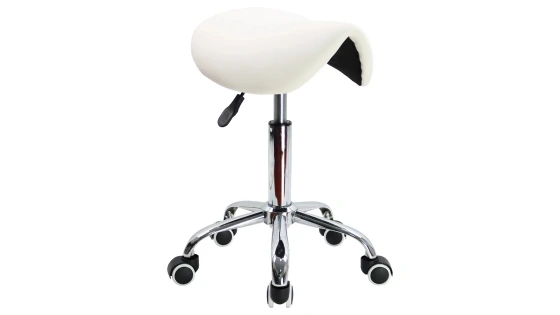
KKTONER Rolling Saddle Stool
Best for:
Desk workers moving from a chair to active sitting, who still want to roll and reposition. Best in shorter, focused stints — an hour here and there, or one seat you rotate into rather than sit on all day.
Why it stands out:
Going from an office chair to a saddle stool means losing both the wheels and the backrest. That’s a lot to give up at once. The KKTONER only asks you to give up one.
The wheels stay, so you keep the roll-and-reposition movement — pushing back from the desk, rolling to grab something, swivelling to face someone.
Losing the backrest buys you posture. With nothing to lean into, you sit upright and your core does the holding.
Two details make it work at your desk. It sits lower than most saddle stools. That drops it to standard desk height, rather than leaving you towering over the keyboard. And the narrow saddle front keeps your legs from splaying, so the whole thing tucks under the desk.
It’s light, assembles in a few minutes, and the PU surface wipes clean.
Pros:
- Rolls and swivels freely, keeping the mobility a fixed saddle would take away
- Backless design keeps you upright and works your core
- Sits lower than most saddle stools, so it fits a standard desk height
- Narrow saddle front stops your legs splaying and tucks under the desk
- Light, with quick tool-free assembly
- Wipe-clean PU surface
Limitations:
The padding is firmer and thinner than the specs suggests, and the weight claim is unverified. It’s sold as thicker than a standard saddle. In practice it’s only around 20% sponge over a hard base. And it’s rated to roughly 21 stone (135 kg) with no test standard behind that figure. Use it for more than a couple of hours and the foam has little give, so you’ll feel the base.
It can feel tippy when you lean or reach. The seat sits high on a single column with a compact base. So the instability is sideways, not downward. Bend to pick something up, or lean out for a drawer, and it can tip more than you’d expect.
It isn’t a full-time chair replacement. Between the firm seat and the upright posture, most people are up and moving inside the hour. That’s the point if you want an active-sitting nudge. It’s a frustration if you wanted to replace your office chair outright.
Key Specs:
- Seat height: adjustable, roughly 45–62 cm (about 18–24.5 in)
- Stated max user weight: 135 kg / 21 st
- Base: five caster wheels, 360° swivel
- Seat: PU faux leather over foam, saddle-contoured
- Frame: chromed metal
- Item weight: 4 kg
- Assembly: required, two to five minutes
Verdict:
Picture how a dentist or hair stylist uses a stool like this. They roll around the chair through a half-hour appointment, then they’re up — to the computer, the till, cleaning down between clients. Short bursts of seated work, broken up by movement.
That’s what this stool is built for, and it’s how to think about it at a desk. As a light, low-effort way to bring movement and upright posture to your work, it does the job well. As a cushioned chair to sink into for eight hours, it isn’t trying to be. Use it the way the people it was designed for do — a seat you move on and off through the day.
Check today’s price on AmazonBest Ergonomic Kneeling Stool
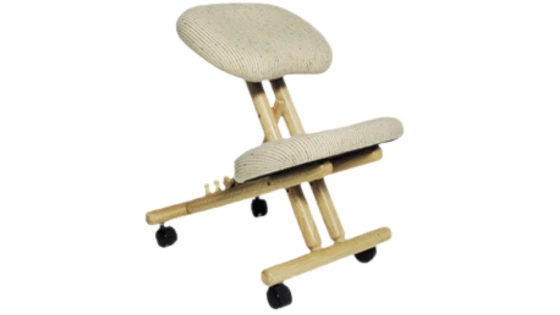
cinius Backless Kneeling Chair
Best for:
Taking the load off your lower back and holding an upright posture through shorter, focused stints. It suits people working on posture or easing lower-back strain.
Why it stands out:
Most kneeling stools come with a metal frame or a lower-grade wood. This one is rubberwood — a named hardwood, not a vague “wood finish”. It’s shaped with rounded, contoured cuts, not the machine-flat look of flat-pack furniture.
There’s a tell in the joinery, too. The frame is cut so it won’t slip out of its height setting when you lift it by any part. What you’re buying is the frame — the part that lasts, and where the money goes.
The backless seat is a deliberate design choice, not a cost-cut. The most common complaint on kneeling stools is the back support. On stools with backrests, some people remove it themselves, because it causes more problems than it solves. Going backless keeps you upright and lets your core do the work.
And… The seat-to-knee tilt adjusts, with three height positions to dial in the fit.
Pros:
- Solid rubberwood frame — sturdier and longer-lasting than cheaper pine or metal kneelers
- Shaped, contoured cuts that hold the height setting and feel considered, not flat-pack
- Backless design keeps you upright and works your core
- Helps shift load off the lower back and improve posture
- Adjustable seat-to-knee tilt with three height settings
- Ships with felt pads as an alternative to the castors
- Compact footprint that tucks under a desk
Limitations:
The castors are the weak point. They can come loose or strip their screw thread over time — sometimes after years, sometimes sooner. It’s the wearable part failing, not the frame: the rubberwood holds up, the wheel fixing goes. And the chair ships with felt pads as a built-in alternative, so a failed castor doesn’t kill it. Swap to the pads, or replace the castor for a few quid, and carry on.
The padding is firm and can soften over time. The seat and knee pads are firmer and thinner than the “non-deformable” wording implies. Some users have found the foam flattens with heavy use. Shin pressure on the knee pad tends to build after thirty to forty minutes — another reason this is a rotate-in seat, not an all-day one.
Tall users may sit too high. Several people over six foot found even the lowest setting perched them high for a standard desk. The felt pads drop the height a touch. But very tall desk workers should check the settings against their desk first — it’s the main fit-related return trigger.
Key Specs:
- Seat height: around 17.5″ (roughly 44.5 cm), three adjustable positions
- Stated max user weight: 100 kg / 220 lb
- Frame: rubberwood
- Seat and knee pads: firm, fabric-covered foam
- Base: castor wheels, with felt pads included as an alternative
- Tilt: adjustable seat-to-knee angle
- Item weight: around 5.4 kg
- Assembly: required, around eight bolts, a few minutes
Verdict:
A kneeling stool helps your back through the angle, not anything clever in the seat. It tilts the seat forward and opens your hips beyond the 90° of a normal chair. That lets your pelvis roll forward, so your lower spine settles into its natural curve rather than slumping into a C-shape.
The cinius is built to that geometry. The seat still carries your weight. The knee pad just braces your shins so you don’t slide forward.
The other trade-offs are easy to live with. The padding is comfy enough for short bursts, not for kneeling all day. The castors can wear, with the felt pads sitting in the box as the fallback. If you want a kneeling stool built to last, and you’ll use it for the active stretches, this is the one.
Check today’s price on AmazonBest Sit-Stand Stool
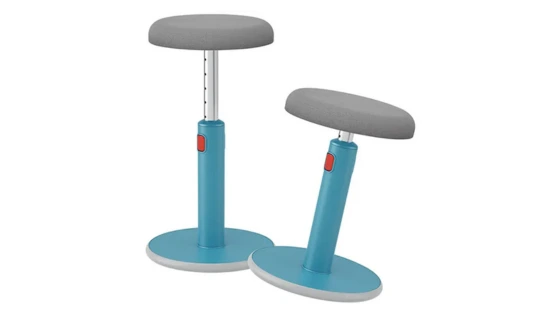
Leitz Active
Best for:
Pairing a stool with a standing or sit-stand desk, who wants to take the weight off their feet without fully sitting down. Perch, rock, and back up. It suits short, active stints. And it’s the grown-up office version of this stool, not the bright classroom “wiggle” seats that generally show for a “wobble stool”.
Why it stands out:
Search “wobble stool” and most of what comes back is built for schools — fixed heights, primary colours, sold for fidgety kids. This isn’t that. It’s a proper office sit-stand stool from Leitz, an established office brand. The difference shows in what doesn’t make the photos: it arrives fully assembled, carries a five-year guarantee, and won a German Design Award in 2022.
The mechanism is the appeal. The rounded base tilts and rocks gently as you sit. Your feet stay flat on the floor, but the weight comes off them. With nothing to settle into, you stay upright and keep shifting. The height range spans a seated desk position up to a standing-desk perch, and it’s light enough to carry between rooms.
Pros:
- Wide height range spans a seated desk and a standing-desk perch
- Rounded base tilts and rocks to keep you mobile and upright
- Arrives fully assembled
- Five-year guarantee
- Reputable office brand with a German Design Award behind it
- Lightweight and easy to move room to room
- Non-slip base that grips hard floors and stays put
Limitations:
The seat is firm and not built for all-day sitting. Like the others here, it’s a perch you rotate onto, not a chair you sink into. Over a full day, some people find it aches after a few hours. They end up alternating with standing every twenty minutes or so. That’s the design working as intended — but a frustration if you expect to stay seated for most of the day.
It doesn’t swivel like an office chair, despite the “swivel” in the name. The seat top doesn’t rotate independently — to turn, you move the whole stool. That’s fine on a hard floor, awkward on carpet. Anyone coming from a free-spinning office chair will notice straight away. Expect rock-and-tilt, not spin.
The seat cover can work loose with heavy daily use, needing the occasional re-seat — a niggle rather than a fault. And the height adjustment can feel stiff, especially if you change it often.
Key Specs:
- Height range: 46–79 cm (≈18–31″) — spans seated to standing-desk perch
- Stated max user weight: 110 kg / around 17.3 st
- Base: rounded, tilts and rocks, non-slip — does not swivel like an office chair
- Seat: firm foam, fabric-covered
- Frame: plastic
- Item weight: 5.5 kg
- Assembly: none — arrives ready to use
- Guarantee: five-year manufacturer
Verdict:
If you stand at your desk and just want to take the weight off your feet now and then, this is built for exactly that. You perch, the base rocks, your feet stay grounded, and you’re back up a few minutes later. It’s the genuine office version of the wobble stool. It arrives ready to use, and the five-year guarantee covers you if the mechanism gives out.
Check today’s price on Amazon