

Wrist discomfort from mousing usually shows up away from the desk — scrolling on your phone, reaching for the remote, hands on your lap during a break. The best mouse pad with wrist support shouldn’t flatten out on you. But that depends on how you use it.

It’s surprising how the little things on your desk can have the biggest impact. Mouse pads with an integrated wrist rest should, in theory, support your wrist. The different materials used provide different levels of support.
Take memory foam for example. Unlike the memory foam in a pillow or mattress topper, padded wrist rests use a much lower density foam — soft enough to feel cushioned initially, but not built to take consistent daily pressure without compressing.
Gel doesn’t cushion the way foam does — it’s firmer, not softer. The reason to choose gel over foam is durability and heat management. Conditions like carpal tunnel, tendonitis, and RSI cause localised inflammation, and an inflamed wrist runs warmer. Foam traps that heat; gel dissipates it.
Best Mouse Pads with Wrist Support
Best Gel Mouse Pad with Wrist Rest
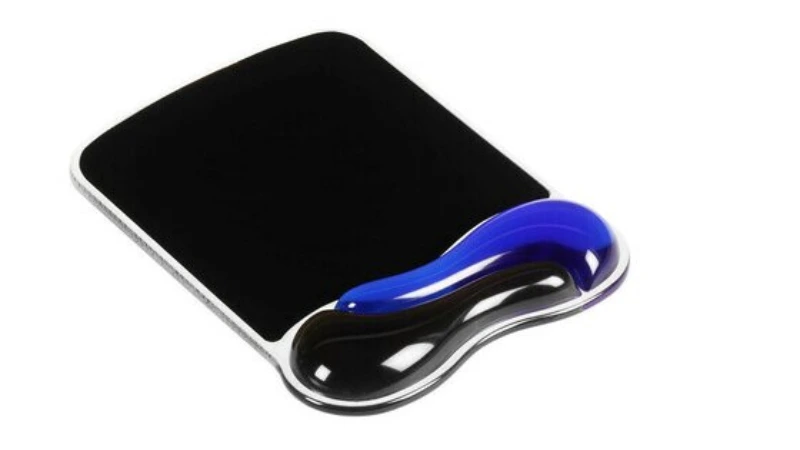
Kensington Duo Gel Mouse Pad with Wrist Rest
View on AmazonBest for:
Those who use the mouse a lot, daily, experience inflammation and prefer a supportive rest that helps soothe and cool the wrist.
Why it stands out:
The Kensington Duo Gel Mouse Pad has been a staple in Kensington’s ergonomic line for at least a decade. In that time it’s proven reliable — some early adopters are on their third.
The reason is simple enough: these are consumables, not a one-and-done purchase. Gel wrist rests last two to three years. When they degrade, there’s a pattern of replacing like-for-like.
What sets it apart isn’t a redesign or an upgrade — it’s that the original design worked and hasn’t needed one. Most products in this space go through multiple iterations. This one hasn’t. It works for most, not all.
Where Kensington gets it right is understanding who’s buying this and why. Conditions like carpal tunnel, tendonitis, and RSI cause localised inflammation, and an inflamed wrist runs warmer. That’s where gel fits in — it dissipates heat rather than retaining it.
The dual-chamber design takes some getting used to, particularly for anyone coming from a single-surface pad. But it helps to understand what a wrist rest is actually doing — it’s not designed for continuous contact. It keeps the wrist off the desk surface and guides a more natural hand position.
During active mousing the wrist lifts anyway; the rest is where the hand returns between movements. Over hours at the computer, that means less overall wrist movement and less time with the wrist unsupported — which is the point. The split design matters less once you’re using it the way it’s intended.
Pros:
- Gel material with ventilation channel dissipates heat rather than retaining it — relevant for wrists that run warm due to RSI, tendonitis, or carpal tunnel
- Holds its structure under daily use without compressing flat — gel maintains support where low-density foam doesn’t
- Non-slip base stays in position across different desk surfaces
- Consistent mousing surface for everyday tracking
- Kensington’s ergonomic credentials back the design — this isn’t a generic pad from an unknown seller
Limitations:
If you’re upgrading from a cloth mouse mat — the most common type — the change in surface material is worth noting. Vinyl tracks differently, and while a standard computer mouse will continue to work as expected, higher-DPI optical mice and gaming mice can become erratic on a smooth vinyl surface. Reducing pointer speed or DPI settings can help, but it doesn’t fully resolve the underlying tracking issue for all mice.
At 19.3 x 24.5cm overall — dimensions that include the wrist rest itself — the active mousing surface is closer to a standard mouse pad size than it might appear in product photos. For everyday use, that’s sufficient, but users who mouse across a wider area or have larger hands have noted the surface feels limiting, with the mouse occasionally extending beyond the edge. If desk coverage is a priority, it may be worth considering an extended mat instead.
Verdict:
The Kensington Duo Gel is the right pick if you’re at a mouse for most of the working day, run a standard computer mouse, and want a support that helps cool your wrist — particularly relevant if you’re experiencing warmth from RSI, tendonitis, or carpal tunnel.
It’s less suited to you if you’re using a high-DPI or gaming mouse, prefer a wider mousing surface, or want continuous full-width wrist contact rather than the guided support the split-chamber design provides.
Where this sits is as among the best gel wrist rests with a mouse pad in one. That being said, the mat is a bit on the smaller side, and being gel, it has a lifespan of a couple of years, though that is with daily use. If you use your mouse regularly, this won’t be a one-off purchase. It will degrade after a while, but for the user it’s designed to help, it’s been doing the same job reliably for a decade.
Best Memory Foam Mouse Pad Mat With Wrist Rest
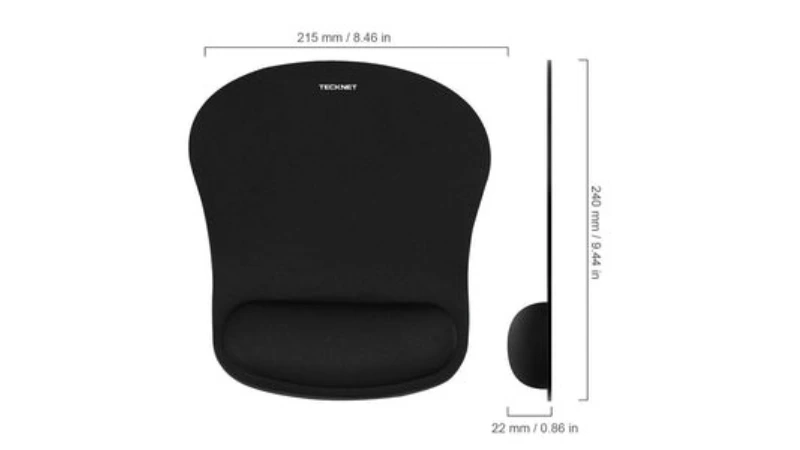
Tecknet Memory Foam Mouse Mat
View on AmazonBest for:
Lighter computer users — those who spend an hour or two at a time at the mouse rather than all day — who want basic wrist elevation.
Why it stands out:
This is a standard mouse mat with a foam wrist rest. It’s not trying to be anything more than that, and for the right user, it doesn’t need to be.
- The fabric mousing surface tracks reliably with standard optical mice,
- The compact size suits smaller desks and laptop setups with an external mouse instead of the trackpad,
- And the foam wrist rest keeps the wrist off the desk surface between mouse movements.
Despite the product listing claiming high-density memory foam, that’s not a material type that realistically appears in mouse pads with wrist rests. What you get is functional low-density foam — soft enough to conform to the wrist, but not built to bounce back quickly under consistent pressure. User reports are consistent: it compresses and forms a depression where the wrist rests, and the time it takes the foam to bounce back can be slow if used a lot.
That’s not a flaw unique to the Tecknet — all foam wrist rests do this. The difference is how quickly it happens and how much it matters for how you use it. For someone leaning on the wrist rest heavily throughout a long session, consider a gel wrist rest instead. For light support — keeping the wrist elevated between movements rather than resting weight on it, this is likely to be the best you’ll find.
Pros:
- Fabric mousing surface tracks reliably with standard optical mice
- Keeps the wrist off the desk surface during lighter use sessions
- Compact size suits smaller desks and laptop setups
- Lightweight and easy to move between setups
- Fast and easy to get used to using.
Limitations:
Foam compression is the biggest concern. A permanent depression forms where the wrist rests — noticeable within weeks under daily use, sooner if the wrist is leaning into the rest rather than lightly touching it. The foam partially recovers between sessions but doesn’t return fully to its original shape over time. For shorter, lighter sessions this is less of a concern. For extended daily use it becomes the limiting factor relatively quickly.
The mousing surface is on the smaller side. Users with larger mice or those who move the mouse across a wider area may find the tracking space limiting, with the mouse reaching the front edge when the wrist is in a natural resting position.
Verdict:
The Tecknet is the right pick for someone who uses a mouse in shorter sessions — an hour or two at a time rather than all day — and wants basic wrist elevation. The foam does what foam does: it conforms, it cushions lightly, and it compresses over time. For light support between movements, that’s enough. For sustained daily use where the wrist rest is taking consistent pressure, the Kensington gel is the more durable choice.
Check today’s price on AmazonBest Keyboard and Mouse Mat with Wrist Rest

Maran 3-in-1 Extended Desk Mat with Wrist Support
View on AmazonBest for:
Integrated ergonomic support — keyboard, mouse, and wrist support on a single unified surface with no gaps and no guesswork about accessory placement.
Why it stands out:
With separate wrist rests, placement is a decision the user has to make — and get right. Too far from the keyboard, too close to the mouse, or slightly offset, and the wrist isn’t where the support is. Over a long session that inconsistency adds up, particularly for anyone already managing carpal tunnel or RSI symptoms where wrist position feels comfortable or not.
The Maran removes that variable. At 70x40cm it covers the keyboard and mouse area as a single surface, with a wrist rest spanning the full width along the bottom edge. The ergonomic setup is built into the product — keyboard and mouse sit on the same surface, the wrist rest is in a fixed position relative to both, and there are no gaps between them where the wrist drops unsupported.
The non-slip base also keeps the keyboard from shifting during use.
Pros:
- Unified 70x40cm surface covers keyboard and mouse area with no gaps between them
- Full-width wrist rest in a fixed position — no separate accessory to place or reposition
- Eliminates the desk edge contact between keyboard and mouse areas that contributes to carpal tunnel symptoms
- Keeps the keyboard stable — no separate keyboard mat needed
- Waterproof surface wipes clean easily
- Non-slip base holds position during use
Limitations:
The wrist rest is foam and that’s not the best material for heavy use. Memory foam compresses whereas gel holds its firmness. For a keyboard and mouse mat pad of this size, the memory foam is a genuine trade-off for the ergonomic benefits of having the keyboard and mouse closer together.
Verdict:
The Maran’s case is straightforward: it replaces the guesswork of separate accessories with a single surface that puts keyboard, mouse, and wrist rest in the right relationship to each other.
For anyone where inconsistent wrist positioning — resting on a desk edge, dropping between accessories, or returning to a slightly wrong position — is contributing to discomfort, that consistency is the practical benefit.
The foam wrist rest is the trade-off. It elevates rather than cushions, and it will compress over time. For passive support between movements, it does what you need it to.
Check today’s price on AmazonWhich Mouse Pad with Wrist Support Is Right for You?
The right choice comes down to two things: how much time you spend at the mouse each day, and the desk space you’re working with.
For a standard desk where the mouse is in use most of the working day, the Kensington Duo Gel is the most capable long-term option. The gel runs cooler than foam and holds its structure better over extended daily use.
For lighter use — an hour or two at a time rather than all day — the Tecknet is the right fit. Foam conforms to the wrist and works well for passive support between movements. The compression timeline only has significance if the pad is in use for hours at a time rather than having longer for the foam to bounce back.
Those who know they need wrist support across the keyboard and the mouse, the Maran is the logical choice. The additional benefit is it removes the guesswork over keyboard and mouse placement on the desk. Your shoulder width will be closer naturally, reducing the shoulder pain that comes from over extending the arm when the mouse is pushed too far away from the keyboard.
- Best Gel Mouse Pad with Wrist Rest : Kensington Duo
- Best Memory Foam Mouse Pad Mat With Wrist Rest: Tecknet Memory Foam Mouse Mat
- Best Keyboard and Mouse Mat with Wrist Rest: Maran 3-in-1 Extended Desk Mat with Wrist Support
FAQs
Is gel or memory foam better for wrist support?
It depends on how long you’re at your desk. Both provide support, but they feel different in use. Gel runs cooler to the touch — useful if you’re dealing with inflammation from RSI, carpal tunnel, or tendinitis — and holds its shape better under sustained pressure. Memory foam moulds to your wrist using body heat, making it comfortable for shorter sessions, but it compresses over time if you tend to lean heavily on the rest. For long hours at the desk, gel tends to hold up better. For lighter, shorter use, memory foam cushioning is more than enough.
Is a mouse pad with a wrist rest better than a wrist brace?
For most people, yes — if prevention is the goal. A mouse pad with a wrist rest encourages a neutral wrist position during use, reducing the strain that leads to conditions like RSI, tendinitis, and carpal tunnel syndrome. A wrist brace restricts movement to let an injury heal — it’s a recovery tool, not a preventive one. If you’re not already in pain, a cushioned wrist rest is the smarter first step.
How do you use a mouse pad wrist rest correctly?
Despite the name, the wrist shouldn’t rest on it — the heel of the palm should. Placing the wrist directly on the pad compresses the carpal tunnel area and can increase pressure on the median nerve, which works against the purpose of having one.
For the mouse, the rest is where the hand returns between movements, not a surface to plant the wrist on throughout.
If the strain persists even with the rest positioned correctly, the best ergonomic mouse type to try next is a vertical mouse — it changes the forearm orientation and removes much of the rotational strain that builds over hours of continuous use.