
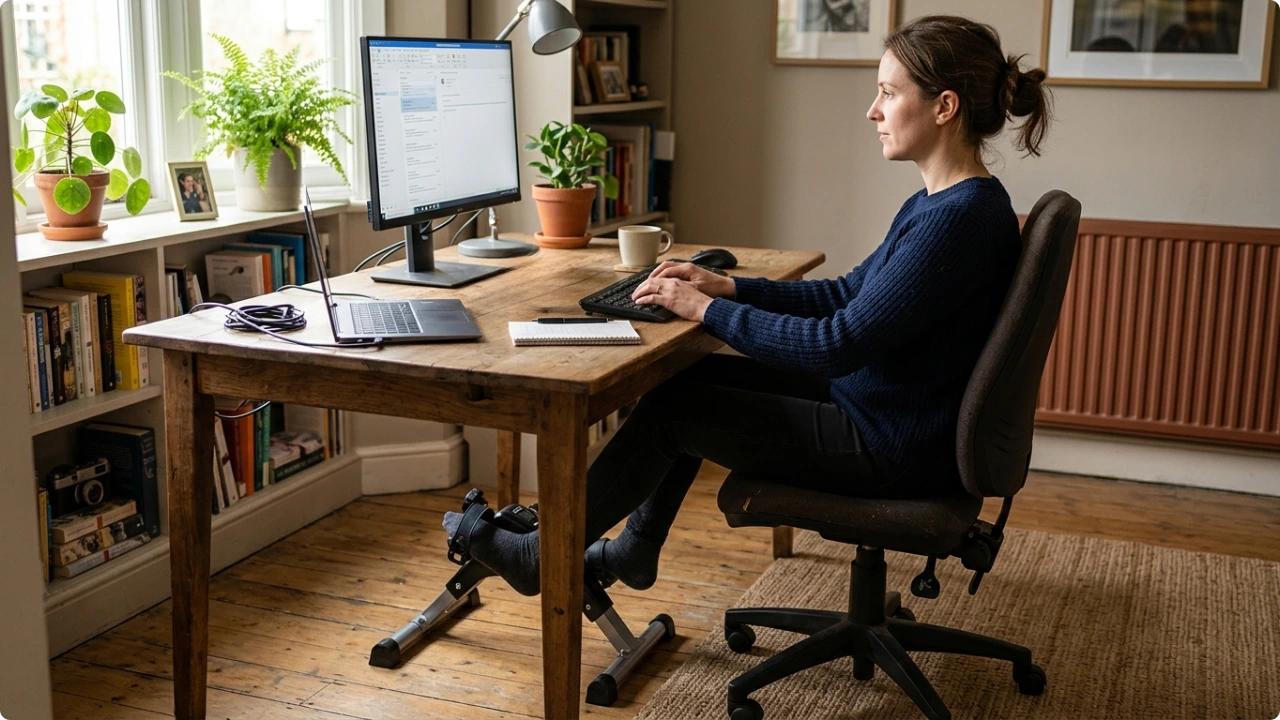
Under-desk bikes keep you moving through long hours of sitting — without breaking your focus or pulling you away from work. On calories, they’ll help stunt weight gain creep, but they won’t burn fat or replace a workout.
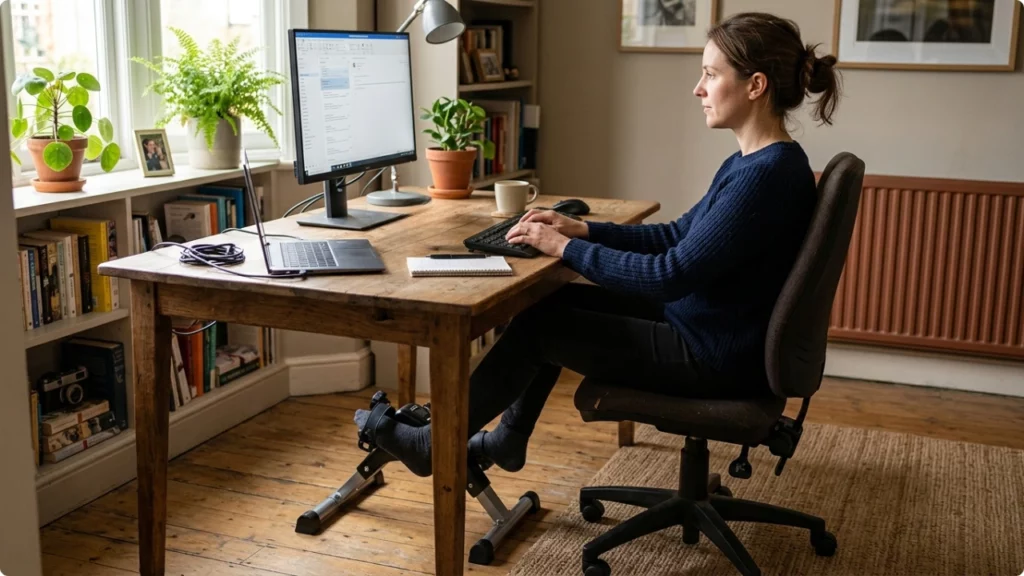
You’ve been at your desk for hours. Your legs haven’t moved since you sat down, and by mid-afternoon there’s that stiff, slightly seized-up feeling that shifting around in your chair never quite shakes off.
Somewhere along the way you’ll have seen them — the little pedal units that tuck under a desk and promise to keep you moving while you work. So the honest question is the obvious one: do they actually do anything, or are they a gimmick?
The short answer is that they do something real — just not the thing the marketing tends to hint at. Here’s what an under-desk bike genuinely helps with, what it won’t do, and who gets the most out of one.
Are Under-Desk Bikes Effective?
What an Under-the-Desk Stationary Bike Actually Does
You’ll see these sold under a few names — pedal exerciser, mini exercise bike, desk cycle — but a stationary bike under the desk describes it most plainly. Take an exercise bike, keep the pedalling, lose the saddle and frame. You stay in your own office chair; only the pedals tuck away underneath.
That’s the point of the design. Nothing to climb onto, no gym kit taking up a corner of the room. You pedal gently while you carry on working.
Keeps your legs moving through a long sitting stretch
A standard office chair does nothing to get you moving — remembering to is left entirely to you. And once you’re locked into a task, getting up is the first thing you forget. A quick walk to the kettle every couple of hours barely registers against all the time in between.
An under-desk bike changes the default. Your legs are turning gently the whole time you work, rather than waiting for a break that might never come. It’s light enough to fade into the background — but it means the longest stretches of your day are no longer completely still ones.
Keeps blood circulating to the lower limbs
Ever stood up after a long stint and one foot’s gone dead? All pins and needles until you’ve stamped it back to life. That’s what stillness does: sit motionless for long enough and blood starts to pool in your lower legs instead of moving freely.
Light pedalling keeps things ticking over. Because your legs are turning rather than parked, you’re far less likely to get that dead, tingly feeling — or the heavy, slightly swollen feet that creep up on you by the end of a long day sat still. In that respect, pedal machines are an effective type of desk exercise equipment. You’ll feel the difference, but it won’t tone your calves or raise your heartrate into the cardio zone like proper cycling could.
Staves off the stiff, seized-up feeling by late afternoon
You know the feeling from a long drive. Three hours on the motorway, and when you finally pull into the services and step out of the car, your legs don’t quite work for the first few paces — stiff, slightly seized, glad to be moving again.
A long day at the desk does the same thing, only more slowly. You feel fine at 9am. It’s when you stand up after the afternoon stretch that everything’s gone tight: the lower back, the hips, the legs that have set into one position for hours.
Keeping your legs gently turning through the day softens that. You’re not letting everything lock up over a long sitting stretch, so there’s less to seize when you finally get up — and you feel the difference where it counts, at the end of the day rather than the start.
Adds gentle movement without leaving your desk or breaking your flow
The usual advice — get up and walk around a few times a day — assumes you can. Plenty of people can’t. If you work a call-centre queue, your team leader wants you in the seat and available, not wandering off between calls. And a lot of remote and hybrid roles now run on activity trackers that quietly clock you as “away” the moment the keyboard goes still.
So the movement has to come to you, or it doesn’t happen at all. That’s the gap an under-desk bike fills. Your hands stay on the keyboard and your eyes stay on the screen — only your legs are doing something different. You’re not stepping away, not pausing the work, not breaking the run of concentration you’ve finally built up.
And it’s deliberately light. A study of 96 office workers had them pedalling while they typed, read, and worked through tasks, and their performance held up the same as sitting still. It’s not meant to be a distraction or a workout. It’s movement that you don’t really notice while you get on with the job.
What an Under-Desk Bike Exerciser Won’t Do
Strip the marketing and an under-desk bike exerciser is doing one simple thing: light pedalling. You’ll have seen the demos — someone pedalling at their desk, grinning, telling you they can really feel it working.
The honest version is far quieter than that. It’s light movement, not a workout in disguise. That’s not a criticism. It’s the reason one slips into your working day without you noticing. But it does mean a few of the things these get sold on simply aren’t on the table. Here’s what not to expect:
Burn meaningful fat or replace a real workout
Sit-down work burns roughly 100 fewer calories a day than the average job did in the 1960s — not because of the typing, but because so much active, on-your-feet work has been automated away and replaced with seated, screen-based jobs. The movement got engineered out.
An under-desk bike adds a little of that back — around 70 to 90 calories an hour over simply sitting. To put that in perspective, your body already burns more than 2,000 calories a day just keeping you alive, and even gentle cycling on a real bike burns three to four times what desk-pedalling does in the same hour.
It’s a genuine nudge, not a lever: enough to help hold off the slow creep of weight gain, nowhere near enough to drive fat loss. For that, you still need actual exercise — and this was never intended to do that.
Build muscle or fitness
It’s a bike, so it’s tempting to picture it doing something for your legs — toning your calves, firming your thighs. Used under a desk, it won’t, and that’s by design.
Many of these have a resistance dial — ten or twelve levels on some models — and the higher settings turn them into a light leg exerciser you’d use on the sofa. But the moment you add enough resistance to actually work the muscles, you’ve made it too demanding to pedal and type at the same time. The two goals pull against each other.
For desk use you want the low end — enough to keep your legs turning without having to think about it. That’s subtle, repetitive movement — good for breaking up a sedentary day, but not the kind of strain that builds or strengthens anything.
If a real leg workout is what you want, there’s a tool for that — it’s not this one though. A proper bike desk, with a seat and adjustable resistance, is designed to be exercised on. An under-desk bike is built to be ignored while you work. Two different jobs, and this one’s quietly good at its own.
Raise your heart rate into cardio territory
Cardio isn’t really about how long you move — it’s about intensity. Getting your heart and lungs genuinely working takes effort, not merely time, and the seating is where an under-desk bike runs out of road.
On a real bike, the saddle puts you in a position built for pushing: your legs extend almost fully, your body’s braced, and you can drive proper power through the pedals. An office chair does none of that. The pedals sit out in front of you and low, your seat’s the wrong height for it, and there’s only so much room to work under a desk. Try to add serious effort and you’ll mostly shove your chair backwards across the floor. You can’t get into a position to work hard — so your heart rate lifts a little, but never into the zone that counts as a workout.
That holds even on the higher-resistance models, or a motorised one that turns the pedals for you. The ceiling isn’t the device — it’s the chair you’re sitting in. You might push it into something more taxing on a sofa or a high stool, where you’ve room and a better angle to drive against. But parked under a desk in an office chair, it stays firmly in the gentle-movement zone — which is the point of a thing you’re meant to forget about while you work.
Replace getting up and moving
Modern desk work has quietly stripped the movement out of the day. The email’s a click away, not a walk to someone’s desk; the meeting comes to you instead of you walking to a room. Whole hours can pass without you standing once — and an under-desk bike, useful as it is, doesn’t fix that part.
The reason is in the motion itself. Pedalling is one narrow, repeated pattern: your feet go round, your knees barely lift, and your legs never take your body weight. Compare that to simply standing up and walking — your whole frame loads and unloads, your joints move through their range, dozens of muscles fire just to keep you upright. That’s the movement sitting takes from you, and pedalling doesn’t give it back.
So treat the bike as something you do alongside getting up, rather than in place of it. It keeps your legs ticking over between breaks — it doesn’t remove the need to take them.
So — are under-desk bikes effective?
For what they’re built to do, yes: keeping your legs gently moving through a long sitting day, without pulling your focus off your work. For burning fat or standing in for real exercise, not really.
If the low-effort, keep-me-moving end is what you’re after, the choice comes down to how the movement happens. Some are fully self-powered — light, but it’s your legs doing the turning. Others are motorised, moving your feet for you, which is a different thing again.
It’s also worth knowing the position itself changes: your feet sit up on angled pedals rather than flat on the floor, so it’s worth picturing how that feels for a stretch at a time before you commit to one.
None of them suits every goal — but then nothing does. If you’ve got a sense of which kind fits the way you’d actually use it, have a look at the best under-desk exercisers worth considering — self-powered and motorised, picked apart so you can match one to how you’d use it.