
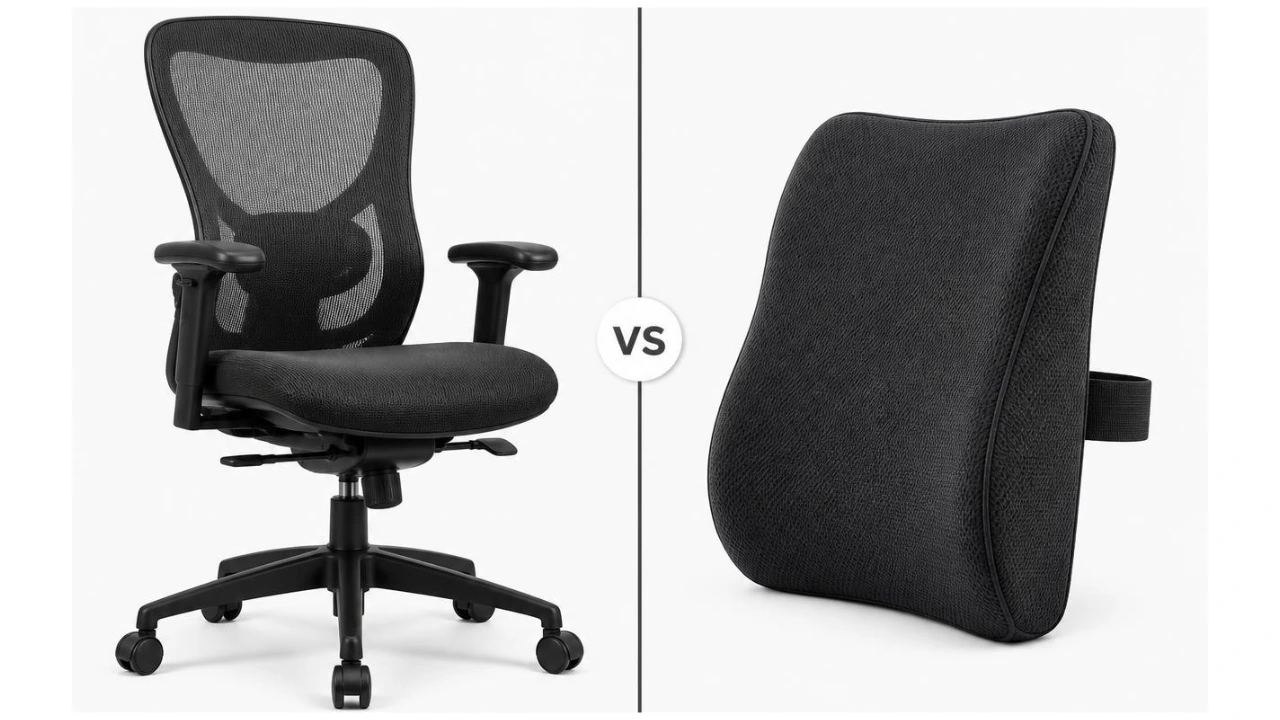
A back support cushion can fix some chairs and do nothing for others. The difference is what’s actually wrong with the one you’re sitting in.
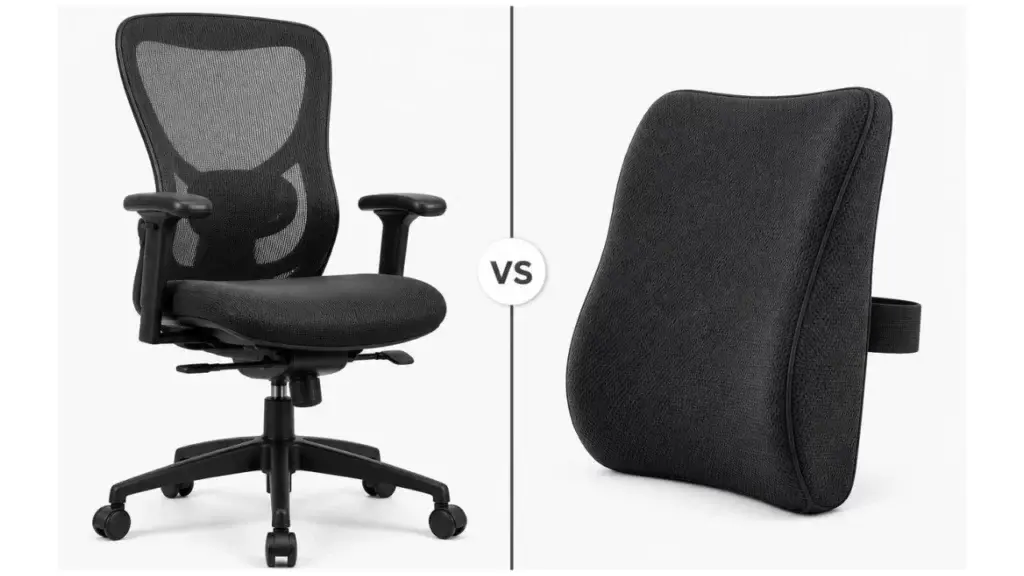
Nobody comes to this question with an empty room. There’s already a chair. Maybe it’s the one you’ve no other option to use (like it’s the one that’s in your workplace, not your home office), or you bought it in a hurry, or it’s a dining chair standing in for one. Your back has started to complain. So the choice comes down to this: fix the chair you have, or replace it.
A cushion costs far less than a new chair. That much is obvious. But cost is the easy part of the answer, and the least useful one. It tells you nothing about whether a cushion will fix your problem. Some faults it fixes cleanly. Others it can’t touch, no matter how good it is. The rest of this comes down to telling those two apart.
On this page
What a Back Support Cushion Specifically Is (and for)
Worth clearing up first, because “cushion” covers two products and only one is the subject here. A back support cushion sits behind your lower back, against the backrest. You’ll also see it called a lumbar cushion. The other kind is the seat cushion, or pad — the one you sit on. They fix different problems. A lot of advice online treats them as the same thing. They aren’t. Everything here is about the one behind your back.
Why the Pelvis Decides If It’ll Be Effective
Why does a cushion help in some chairs and not others? It comes down to where the support lands. Your hips — your pelvis — are the base of your spine. They set how everything above them sits. Let your hips roll back and your lower back rounds over. Keep them upright and your lower back settles into its natural curve on its own.
A chair works on your hips from underneath. Seat height, seat depth, and the tilt of the seat all decide how your hips sit. That’s why a well-set chair can hold good posture with nothing added.
A cushion works higher up. It props up your lower back directly. It doesn’t touch the hips that set the curve in the first place. If your hips already sit well, that prop is often all that’s missing, and the cushion does real work. If your hips are tipping back, the cushion holds your lower back in place while the base underneath keeps moving. That’s why some faults sit beyond it. Hold onto that difference and the rest of the decision gets simpler.
What an Ergonomic Chair Does that a Cushion Can’t
A cushion adds one thing: support for your lower back. An ergonomic chair adjusts several things. A few of them are beyond anything you can prop against a backrest.
Seat depth is the clearest. An ergonomic chair lets you set how far the seat reaches. You match it to your thigh length, so the seat supports you without the front edge pressing behind your knees. A cushion changes this only by accident. It pushes you forward, which makes the seat shallower. On a seat that’s too deep, that’s two fixes in one. On a seat that already fits, it perches you near the edge. Whether it helps depends on the chair you start with.
Armrests matter more than they look, too. Set them wrong and your shoulders and upper back take the strain. If yours adjust, set them so your shoulders sit relaxed. If they don’t adjust, taking them off often beats leaving them at the wrong height. There’s more on that discussed about how to make an office chair more comfortable. Either way, this is a chair adjustment. A back cushion won’t do it.
Then there’s recline. A good chair lets you change the angle between seat and backrest, and lock it there. Leaning back shifts your weight off your lower back and onto the backrest. Nothing static can do that. Not every chair has a working tilt or a lock. Where a chair does, it’s doing something a cushion can’t. This is the one place the chair simply wins.
The Biggest Limitation of a Back Support Cushion: Seat Height
The limit of a cushion shows up clearest with seat height. And it comes straight back to your hips. If the chair sits too high, your feet dangle, or only your toes reach the floor. Now there’s nothing under your thighs to keep your hips level, so they roll back. A cushion can’t reach that. It holds your lower back in place while your hips keep tipping underneath. That’s the one fault a back support cushion will never be able to fix.
This isn’t really a knock against the cushion. It’s just a line around what it can do. When the problem is height, the fix goes under your feet, not behind your back. A footrest brings the floor up to meet you. That’s another discussion though – whether or not footrests help with lower back pain. Check this before you spend on a cushion, because a cushion won’t do a footrest’s job.
What a Back Support Cushion Genuinely Fixes
Set against all that, there’s one fault a cushion handles better than anything else: a flat backrest. Plenty of chairs have no shape to them at all. Dining chairs, older office chairs, most of what you inherit at a shared desk. A cushion puts back the curve the backrest is missing. That’s exactly the job it’s built for.
Its real edge over built-in support is that it moves. A chair’s built-in lumbar support sits at one fixed height, set for an average back. That back may not be yours. A cushion slides up or down until it meets your lower back where the curve actually is. Most people don’t realise they’re missing that until they have it.
Which leads to a point people miss: a cushion can improve a good chair too. Even a proper ergonomic chair has its lumbar support fixed in place. If that support lands above or below where the curve on your back is, a cushion set to your own back does better. So this isn’t only a fix for bad chairs. Plenty of decent chairs can still use one.
A Worthwhile Consideration for Home and Hybrid Workers
One more thing tips the balance if you split time between home and an office. A cushion isn’t tied to a chair. The good chair you set up at home stays at home. The office chair, the dining chair filling in for a week, the car seat on the commute — none of those move with you. The cushion does. If you work across setups you don’t all control, that portability is a real advantage, not a footnote. It’s a reason a cushion can beat a single chair you can only sit in one place.
Which One You Actually Need
The decision comes down to naming the fault.
Is the problem just a flat backrest and a missing curve? Seat height fine, feet flat, chair reclines? Then a cushion fixes it, and fixes it cheaply.
Is the problem underneath you? Seat too high, wrong depth, no recline at all? Then a cushion won’t reach it, and the honest answer is to change the chair.
Most chairs sit somewhere between the two. So the useful move is to work through the faults one at a time, rather than pick a side up front. Once you know a cushion is the right call, then reviewing the back support cushions worth buying narrows it down by the type of support you need.