
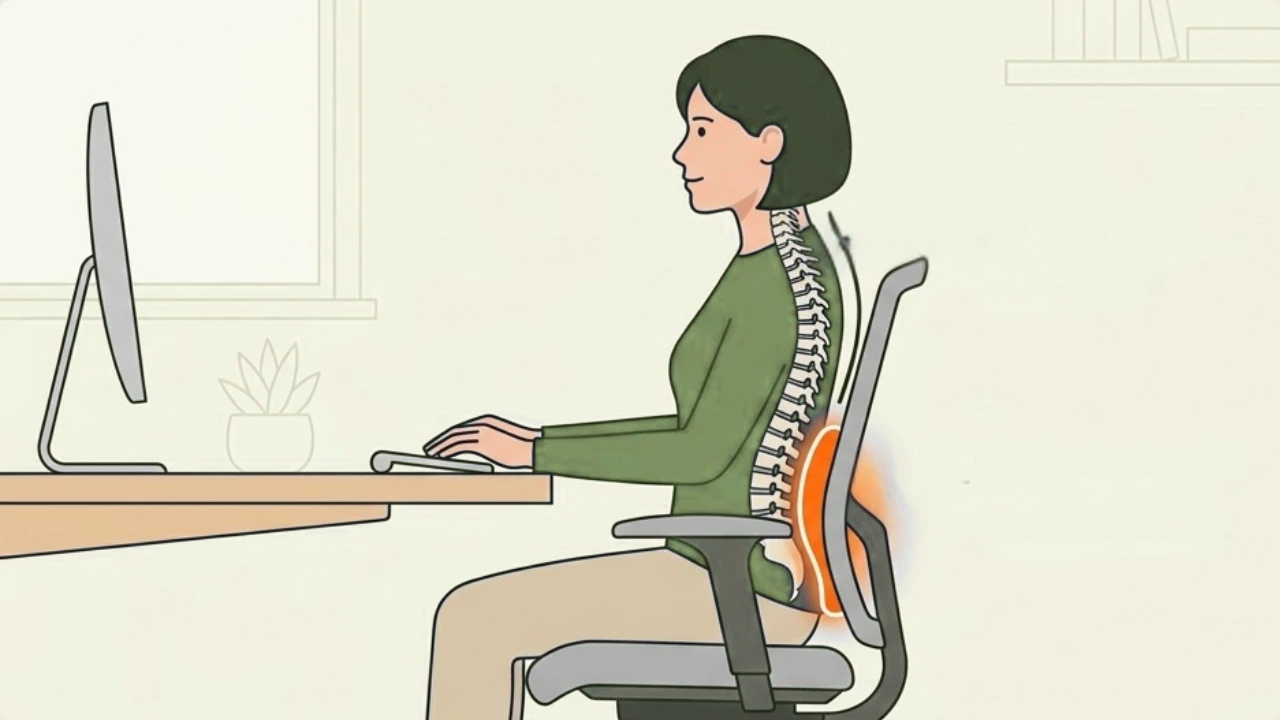
Lumbar support is lower back support. It can be integrated in office chairs, or an add-on to the backrest. It’s designed to fill the curve on a person’s lower back. The caveat is where that support is on the backrest.
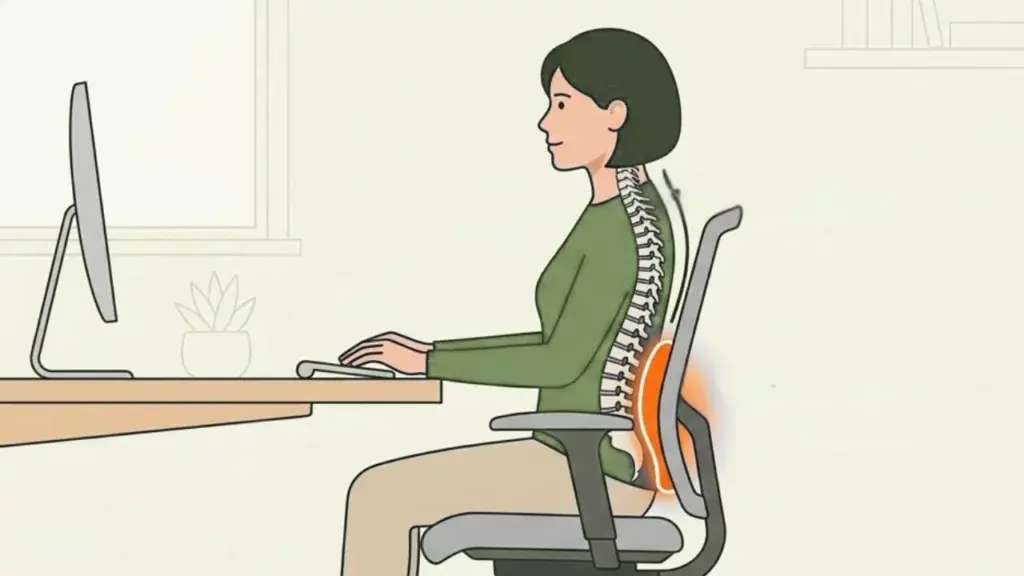
Lumbar support in office chairs doesn’t tell you much on its own. There are several types. Most of them dance around the thing you actually need to know.
S-curve lumbar support. Dynamic lumbar support. Contoured lumbar backrest. These labels may all be accurate. But none of them tell you if the chair will help or hurt your back after hours at your desk.
Here’s the lowdown. Lumbar support in office chairs is the part of the backrest that supports the lower curve of your back. That’s the S-shaped curve just above your belt line.
The smarter question is this: where is the lumbar support?
Everyone is a different height. So where the support sits on the backrest decides whether it fits your back. That one point runs through the rest of this post.
On this page
What lumbar support actually does
When you first sit down, you hold yourself upright. Your lower back keeps its curve.
After a while, the muscles doing that job get tired. You start to sink. Your pelvis rolls back. The curve flattens out.
That flat, slumped position is the problem. Your lower spine isn’t built to hold it for hours. The load your curve normally shares gets pushed onto your discs and soft tissue. The muscles around them work harder. That’s the stiff, achy feeling that builds over a long day.
Lumbar support fills the gap between the chair and the small of your back. Now the slump has nowhere to go. Your spine stays in its natural shape instead of collapsing.
One thing to be clear on. This is comfort and posture support. It is not a medical treatment. If you have a diagnosed back problem, good support can make sitting easier. But it won’t fix the cause. For that, speak to a professional.
Is lumbar support the same as an ergonomic chair?
No. And it’s worth clearing up, because the two get used as if they mean the same thing.
Lumbar support is one ergonomic feature. An ergonomic chair usually has several. Adjustable armrests. Seat height and depth. Recline and tilt. Sometimes a headrest. Lumbar support is the one aimed at your lower back.
So neither word promises the other. A chair can have loads of adjustments and still get your lower back wrong. A plain chair can have decent lumbar support.
“Ergonomic” on the label is not a promise your back is looked after. And “lumbar support” is not the whole ergonomic picture. If you’re weighing up a full chair, it helps to know what an ergonomic chair gives you beyond the lumbar pad.
The types of lumbar support (and the one that matters)
Most guides sort these by how advanced they are. That misses the point. The real question is simpler. Does the support move to you? Or are you stuck with wherever the designer put it?
Fixed (built-in). The curve is moulded into the backrest. It can’t move. It sits at one height, set around the average person. If your curve sits there, great. If it sits higher or lower, you’re out of luck. A nicer backrest doesn’t move the curve. It just makes a nicer shape in a fixed spot.
Height-adjustable. The lumbar pad slides up and down. Often in and out too, to change how firmly it presses. This is the type that solves the position problem. You line it up with your curve, not the average one. Product titles rarely spell this out. “Lumbar support” could mean fixed or adjustable, so always check the description.
Dynamic (self-adjusting). Found on higher-end chairs. It flexes and shifts a little as you move. It still works within a set range. But it adapts more than a fixed pad.
External add-ons. Separate cushions, pillows or rolls for a chair you already own. These give you the most control of all. You place the support exactly where your curve is. The catch: some slide out of place over a long day if they don’t strap on well. Placement matters.
Why a good chair can still get your back wrong
This is the part product pages leave out.
Chairs are built around an average back. But we’re all different heights. The small of your back sits at a different point up your spine than the next person’s.
A built-in curve has to go somewhere. So it goes where the average person’s curve falls. If you’re taller or shorter than that average, the support lands above or below your curve. And if it’s fixed, you can’t move it. The chair can be well made and still support the wrong spot on your back.
There’s a sneakier version of this too. A chair with lots of adjustments can sort out other aches. Get the armrests right and your shoulders relax. Get the height right and your neck settles. But if the lumbar still isn’t at your curve, back pain can show up in their place. It feels like the chair fixed one thing and broke another. Really, the back was never supported properly to start with.
When lumbar support won’t help
Lumbar support is useful. But it isn’t magic. It’s only fair to be straight about the limits.
Set it too deep and it stops helping. It starts pushing your upper back away from the chair, or arching your spine more than it wants.
Set it at the wrong height and it does very little. It isn’t filling the curve.
And no support cancels out the basic problem. Sitting still for hours isn’t good for you. Moving and getting up often does more than any pad or cushion.
How to set your lumbar support to fit you
Got adjustable support? A couple of minutes setting it up beats any spec on the box.
- Sit back fully. Get your bottom and upper back against the backrest. No perching on the front edge.
- Find the small of your back. That’s the curve just above your belt line.
- Set the height so the support fills that curve. Not up your mid-back. Not down by your seat.
- Set the depth so you feel held. Not so much that it shoves you forward.
If the support is fixed and won’t line up with your curve, that’s your sign. You need height-adjustable lumbar, or a support you can position yourself.
So what should you do?
It comes back to one question. Not “does this chair have lumbar support?” But “can I get support where my back needs it?”
Buying a chair? The spec to insist on isn’t lumbar support. It’s height-adjustable lumbar support. That way you move it to your own curve instead of hoping you match the average. It’s worth knowing what else a proper ergonomic chair does before you commit.
Happy with your chair otherwise? Or stuck with the one you’ve got? A positionable back support cushion does the one thing a fixed curve can’t. It lets you place the support exactly where your curve is. It won’t match a full ergonomic chair for recline and adjustment. But for getting support in the right spot, it’s the most direct fix there is.