
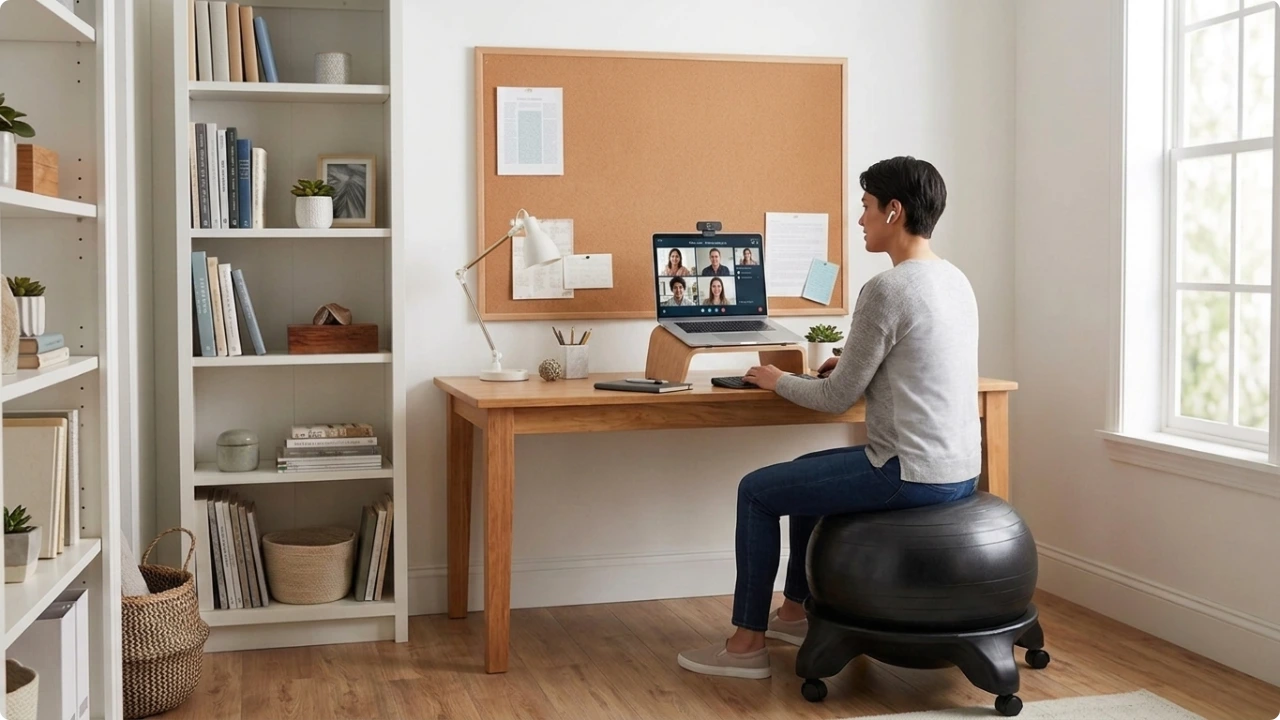
A balance ball chair is good for short bursts of active sitting. It is not an all-day chair, and may not provide the back or hip pain relief some may expect.
Some say balance ball chairs are great for this, that, and the next thing. A few reviewers agree. Yet the research does not back up the experience, or the claims.
So can they work your core? Improve your posture? Ease the ache of sitting still most of the day? The answer depends on how you use one, and on what you expect it to do.
What Balance Ball Chairs Can (and Don’t) Help With
Active sitting vs passive sitting
A normal office chair is built for passive sitting. It holds you in one position. The backrest, the armrests, the padding all support your body. You can settle in and stay put.
A balance ball chair does the opposite. There is usually no backrest to lean on, and no arms to prop against. To stay upright, you keep making small adjustments. That is active sitting.
A balance ball chair differs from a fitness or exercise ball. The difference is the setup around the ball. A chair version often sits in a ring or a frame, sometimes with a weighted base or castor wheels, to make it steadier at a desk.
Balance ball chairs were a fad at one time. Big companies, Google included, put them in their offices. One even turned up in the US version of The Office, where Dwight swapped his chair for a “fitness orb”.
The fad was all about fitness. Once the research came in, most offices went back to normal chairs, and the ball chair settled into a smaller niche. Useful for some people, for specific reasons — not for all-day, every-day sitting.
The Benefits of Balance Ball Chairs
Numerous claims are made about these chairs. Only two benefits are backed by studies.
- Movement! On a ball, you make constant tiny adjustments to stay balanced. Your posture shifts and your core stays engaged.
- A break from passive sitting. Swapping to a ball for part of the day gives your body something different to do. Used in a rotation — a short spell on the ball, then back to a proper chair — it adds variety.
That core engagement is the part people misread. Balancing on a ball works your core a little, but it is not a workout.
It also has a sweet spot. Because the effect only lasts a short while, a ball chair suits short, low-focus tasks best:
- reading emails, documents, or manuals
- brainstorming, where a bit of movement helps
- phone calls, where you can shift and sway
- video meetings, where it stops you slouching
For focused work like detailed typing, the balancing pulls at your attention and your focus drifts. That is a job for your normal chair.
If you work from home, the use case is simple. Sit for an hour or more and you feel it when you stand — tight legs, a bit of stiffness. A short spell on a ball keeps you moving just enough to take the edge off that, without pretending to be exercise.
Where Balance Ball Chairs Fall Short of Expectations
Sit on a ball for too long and the drawbacks show up.
Researchers at the University of Waterloo compared sitting on a ball with sitting on a chair. The main thing they picked up on: the longer you use it, the more discomfort you feel. That comes largely from the extra strain on the spine when there is no backrest to share the load.
Ergonomics researchers at Cornell make a related point. A ball on its own gives no lumbar support, so nothing holds the natural curve of your lower back. That is fine for a short period, but use a balance ball as an office chair all day and you are likely to feel it in your back.
Then there is the wobble. It is the whole point of the chair, but it cuts both ways. For anything that needs focus, part of your attention goes into staying balanced. On a hard floor a ball can also roll away from your desk — though the better chair versions sit in a weighted base that holds them in place.
The takeaway: a ball chair is a short-burst tool. Use it for hours and you are more likely to end up sore.
Can a balance ball chair help with back or hip pain?
This is what many people really want to know. The answer is not a flat yes or no. It depends on the cause of the pain, and on how you use the chair.
Back and lower back pain
A ball chair will not fix back pain, and research points to it being not good for it either. Most have no lumbar support, so nothing holds your lower back the way an ergonomic chair does. A few models do add a backrest, but most do not.
For some people, short spells of active sitting feel better than staying in one position, because the movement stops them stiffening up.
Used well, it can sharpen posture awareness — fifteen to thirty minutes at a time — and some find their lower back eases when they alternate a ball with a normal chair rather than sitting for several hours on one.
Long sessions are where it turns. Sit too long and the core tires, you start to slouch, the lower back over-curves, and muscles like the psoas get overworked. With no backrest to support you, that can add strain rather than ease it, especially if you already have back pain.
So the chair is a tool, not a treatment. Whether it helps comes down to how you use it, and back-pain relief is not something to switch to one for. Ergonomic seating specialists are best placed to advise on the different types of chairs available, and which is best for what.
Hip pain
Hip pain works differently. A lot of hip discomfort from sitting comes from staying positioned at 90 degrees for hours — knees and hips at a right angle, hip flexors held tight.
A ball chair does not change that angle. You are sitting in much the same position, so it is not really good for hip pain caused by the fold itself.
For hip pain specifically, the seat that helps — the better option, not necessarily the best — is one that keeps you actively sitting while opening the joint. A saddle stool does that by opening your hips beyond the 90° of a normal chair, dropping your knees below your hip line — the opposite of what a ball does to your hip position when seated.
How to Use a Balance Ball Chair Properly
To get the most from a balance ball chair, a few things are worth knowing.
- Get the sizing right. This one matters most. The common sizes are 65cm and 75cm, with the taller size suited to taller users. They work on air, so you can fine-tune the feel by letting a little out — though that costs you some firmness. As a guide, sit with your feet flat on the floor and your hips a touch above your knees.
- Keep it inflated. A ball that is too soft sinks and kills the active-sitting effect. Too hard and it is a battle to balance. Firm with a little give is the target. Expect a top-up every week or two to hold that.
- Use it in short bursts. Swap onto the ball for part of the day, then back to a properly set up chair before you start to ache. The benefit is in the switching, not in toughing it out over hours. Pair it with a proper chair and you get the variety without the soreness.
The Bottom Line
So, are balance ball chairs good? For the right job, yes.
They are good for short bursts of active sitting, and for breaking up a day spent sitting still. They are not an all-day chair, and they are not a treatment for back or hip pain.
If that short-burst role fits how you work, the next thing to determine is the type that supports how you’ll use it. The key is in the design.
Some of the best balance ball chairs sit on an inflatable ring for stability, others sit in a frame with casters mimicking the slide and glide of an office chair, and others are simple weights inside to counter rolling.