
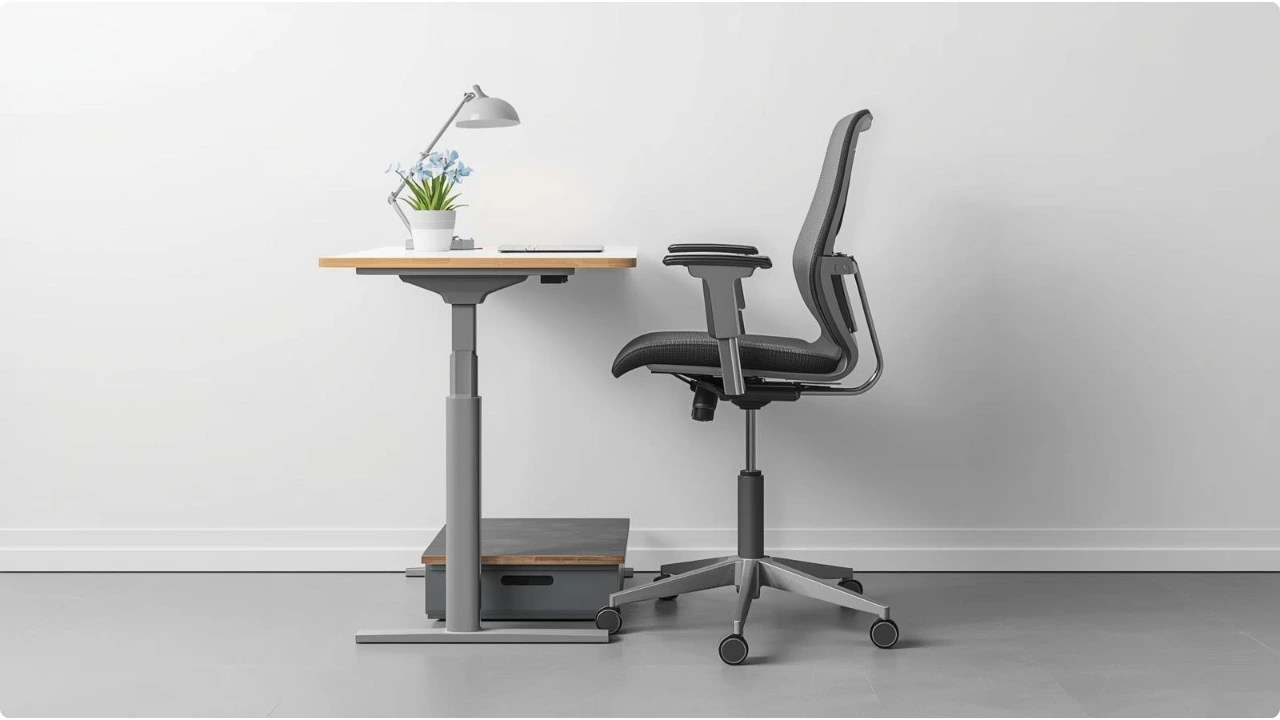
At a small desk, if raising the chair leaves your feet off the floor, a footrest restores contact beneath them.
Small desks are often fixed height. To reach the desk surface, the chair rises. As it rises, the floor drops out of reach.
When the feet lose stable support, the lower body has nothing to settle against. A footrest replaces the missing floor so the setup remains balanced.
When a Footrest Helps — and When It Doesn’t
When Desk Height Can’t Be Changed
A footrest compensates for fixed-height furniture.
This is common in small rooms where desks prioritise footprint over adjustability. Slim writing desks, wall-mounted tops and compact workstations rarely offer height control.
You raise the chair to align your elbows with the desk surface. Lowering it again drops your arms too low. The chair must remain elevated.
When that happens, the floor effectively drops out of the setup. A footrest restores support beneath the feet.
If desk or chair height can be corrected instead, that is usually the cleaner solution. In many compact desks, adjustment simply isn’t available.
In these setups, clearance becomes the next constraint to consider. Before adding a footrest, check knee clearance, distance from the chair base to the desk front, and any obstructions underneath.
When Feet Don’t Rest Flat After Adjusting the Chair
Adjust the chair first.
Set the seat height so your elbows align with the desk and your thighs sit close to parallel with the floor. Once the chair is correctly positioned, check your feet.
If they are dangling, if your heels lack stable contact, or if you feel pressure behind the knees, the floor is effectively too far away.
When correct chair height removes foot support, a footrest replaces it.
Position it directly beneath the knees and heels. Avoid placing it too far forward or using it as a leg prop. Its role is simple: to restore stable contact beneath the feet.
When a Footrest Can Create Problems in Small Spaces
In compact setups, placement becomes the constraint.
A footrest should sit directly beneath the knees. In tight desks, that position places it close to the chair base. When the rear edge contacts the chair wheels, users often push the footrest forward to avoid interference.
As the footrest moves forward, the legs extend. Extended legs reduce contact with the chair back and increase the likelihood of slouching — particularly in shallow under-desk spaces where depth is limited.
Consistency also matters. If the footrest must be repositioned every time you sit down, usage becomes inconsistent. In small desks, simpler placement is easier to maintain.
When a Footrest Is Not the First Fix
A footrest is situational.
Before adding one, check whether the issue can be corrected at the source. Adjust chair height first. If possible, adjust desk height. Remove or reposition under-desk obstructions such as keyboard trays or storage rails that limit leg space.
If the floor remains usable once these adjustments are made, use it.
A footrest compensates for height constraints. It is not standard equipment for every desk setup.
Adding equipment before correcting alignment often introduces unnecessary bulk in compact spaces.
Footrest Placement in Small Desks
Keep placement simple.
Position the footrest directly beneath the knees and heels so it replaces the missing floor rather than extending the legs forward.
Avoid pushing it too far forward to clear the chair base. Ensure the rear edge does not interfere with the chair wheels.
In shallow under-desk spaces, avoid strong forward tilt. Flat and stable remains the baseline in compact setups.
In compact desks, depth and clearance dictate placement more than features.
Next Step
Once the need is clear, selection becomes a matter of type and fit.
- Understand how different designs behave in tight spaces: Best Type of Footrest for Small Desks
- Confirm the right size for depth and knee clearance: What Size of Footrest for Under Small Desks?
- Compare compact adjustable models (UK): Best Adjustable Footrest for a Small Desk (UK)
Summary
A footrest is not default equipment for a small desk. It is a response to a height constraint.
If the desk or chair can be adjusted instead, correct that first. When the chair must remain elevated and the floor drops out of reach, a footrest restores stable contact beneath the feet.
In compact setups, placement matters as much as selection. Clearance, depth and interference with the chair base determine whether a footrest improves the setup or introduces new problems.
Once the need is confirmed, the next step is choosing the right type and ensuring it fits the available space.