
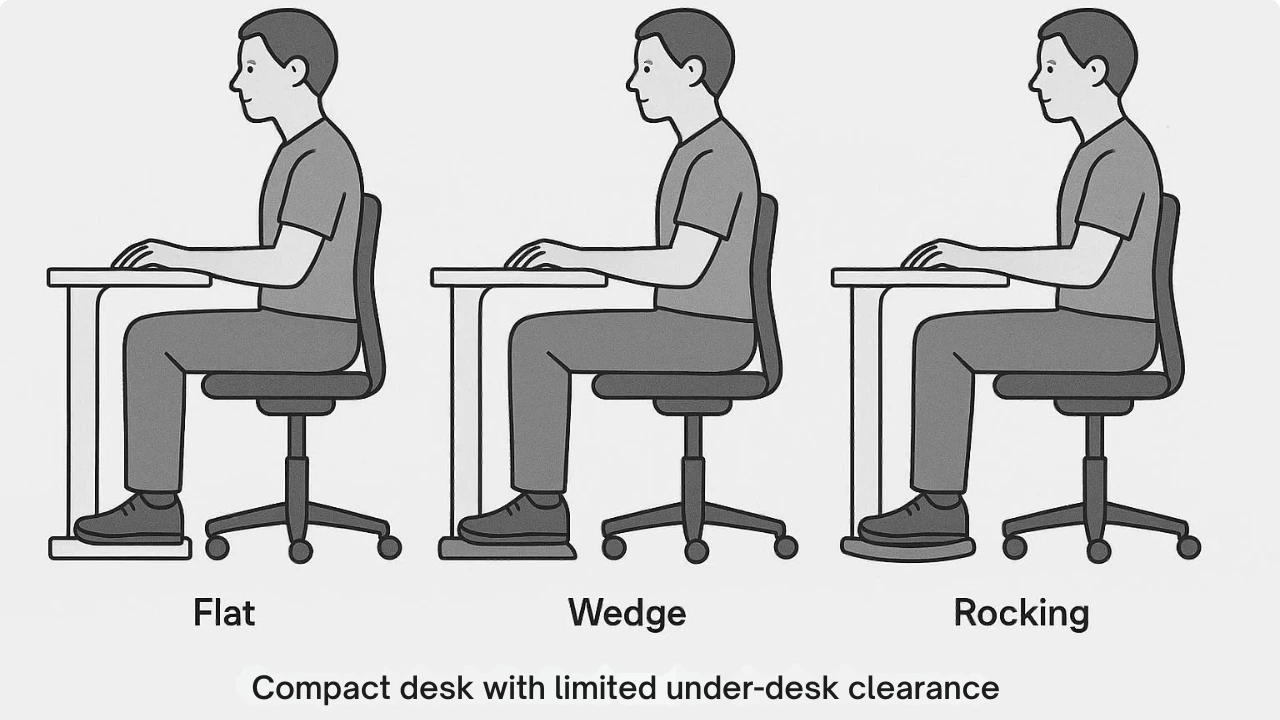
When under-desk space is tight and your feet don’t naturally rest flat, a footrest feels like the obvious fix — as long as it’s compact enough to slide underneath.
A footrest can clear the underside of your desk by two inches and still cause problems. It can be technically compact but functionally awkward — pushing your feet forward at the wrong angle, or rocking into the desk base every time you shift position. Fit isn’t the same as compatibility.
In compact setups, behaviour matters more than measurements. Rocking, angled and flat platforms behave differently once clearance is limited.
How Different Footrest Types Behave in Tight Spaces
Why Small Desks Change the Calculation
Small desks restrict leg space beneath them. Forward extension shortens, knee clearance drops, and the gap between chair and desk panel tightens.
In extreme setups — such as a fold-away laptop tray paired with a stool — underside depth is minimal. Add a footrest without accounting for movement space and it becomes an obstacle.
- Shallow depth limits how far forward a footrest can sit without contacting the desk structure.
- Low knee clearance makes thicker platforms a liability.
- Limited arc space restricts rocking or tilt mechanisms.
Each type responds differently to those constraints.
Flat (Fixed) Platforms — Stable, Low, Predictable
Flat footrests are the most straightforward option in compact setups. They sit close to the floor, require no movement clearance, and remain fixed once positioned.
Trade-off: no movement. The Angle is fixed.
In very shallow setups, that can push feet forward and reduce contact with the chair back.
They suit spaces where stability matters more than adjustability.
Foam block designs with removable layers adjust height by stacking. Mechanically, they behave like fixed platforms — no pivot, no arc requirement — but stacking increases vertical bulk. In shallow setups, clearance becomes the limiting factor.
Angled or Wedge Footrests — Low Profile, No Mechanism
Wedge footrests are structurally simple. There’s nothing underneath them. No frame, no pivot, no mechanism. The footprint you see is the footprint they use.
They sit low. Most designs are thinner than flat platforms with raised edges or rocking bases. The incline is built into the shape, so there’s no added bulk.
Limitation: the angle is fixed. If it doesn’t match your desk and chair height, it can’t be adjusted. Not suited to shared desks where users sit at different heights.
Rocking Footrests — Movement Versus Space
Rockers allow movement so they require forward clearance.
The platform tilts forward and back. In shallow under-desk spaces, that arc becomes the constraint. The front edge can travel far enough to contact the desk structure, and the motion feels restricted when depth is limited.
They aren’t ruled out entirely. If under-desk depth is adequate — even on a small desk — a compact rocker can work. Depth is the deciding factor, not desktop size.
Adjustable Platforms — Flexible, Higher Profile
Adjustable footrests compensate when desk height can’t be changed. They allow the platform angle or height to be modified to suit different sitting positions.
Trade-off: added bulk. Adjustable platforms increase height and depth. In compact setups, that reduces usable clearance.
They’re suited to fixed-height desks or shared workstations where users sit at different heights. In very tight spaces, fixed designs occupy less space.
A low-profile compact adjustable footrest can work where depth allows.
Which Type Works Best in Tight Under-Desk Areas?
The right choice depends on which constraint is most limiting in your setup:
- Very shallow under-desk depth → flat or wedge; these eliminate the risk of the footrest travelling into the desk structure
- Low knee clearance → low-profile angled wedge; thinner base, no added mechanism height
- Long sessions with adequate depth → compact rocker; movement without the bulk, provided there’s room for the arc
- Shared desk or variable users → low-profile adjustable model, accepting the slight increase in footprint
In small-desk setups, wedge designs resolve multiple constraints at once: no mechanism height, no depth requirement, predictable footprint.
Type determines how a footrest behaves in tight spaces. Once you know the type that suits your setup, the next step is making sure the size of footrest physically fits — including depth and clearance.
Quick Decision Guide
- Your knees already feel close to the desk underside → choose a low-profile wedge or flat platform (avoid adjustable and rocking designs with thick bases)
- Your feet dangle but under-desk depth is shallow → choose a flat platform or thin wedge positioned close to the chair
- You shift position often during long sessions → choose a compact rocker, but measure the forward clearance first
- You share the desk with someone at a different height → choose a low-profile adjustable platform
- You want the least intrusive option overall → choose a wedge; no mechanism, no moving parts, smallest effective footprint
If you’re still deciding between height, angle and movement features, refer to the advice on choosing a footrest specifically for compact desks.