
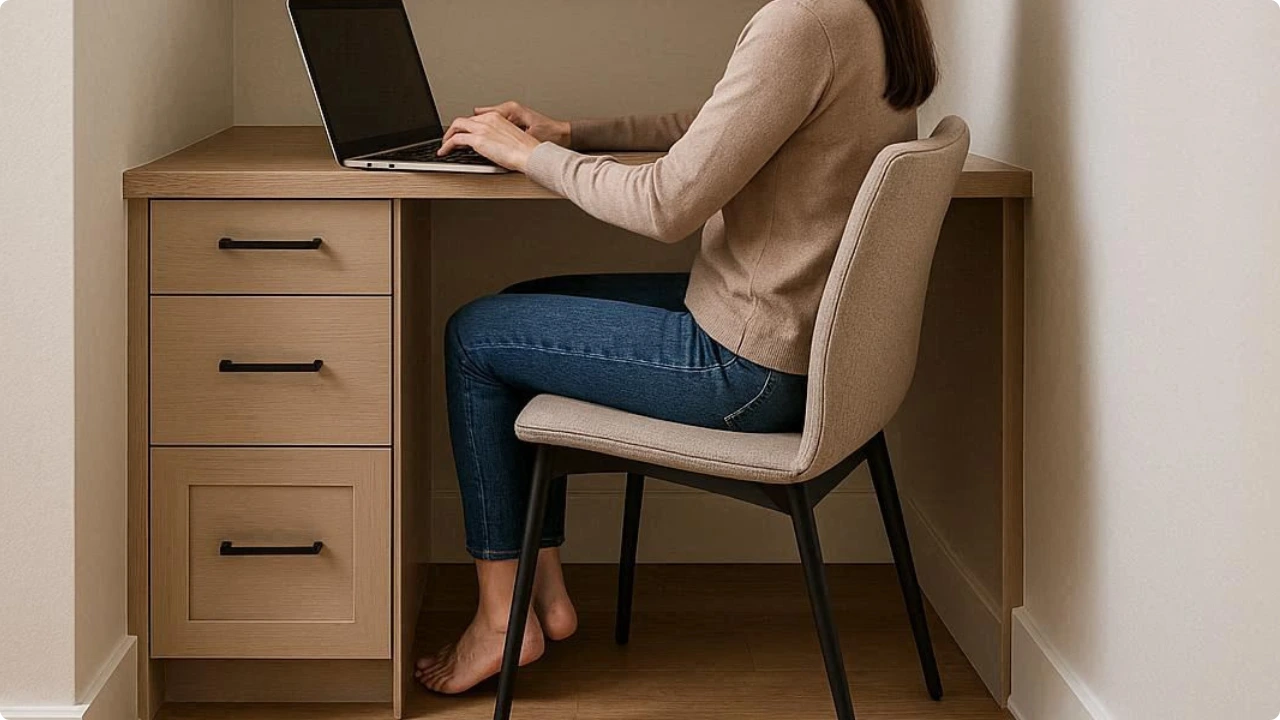
Small desks can leave barely enough room to rest your shoes while you work, let alone fit anything extra underneath. Finding a footrest for that tight space is a challenge — but not impossible.
On compact desks, floor space fills up fast. Desk legs, support panels, keyboard trays, and drawers all reduce the usable area underneath. What looks roomy from the front often isn’t once you sit down.
That’s why “what size footrest is best” isn’t a one-number answer. The best size is the one that fits comfortably within your under-desk space without restricting your legs or forcing you to rearrange your setup. Measure first, then decide.
Determine the Best Size of Footrest for Small Workspaces
Start by Measuring the Space Under Your Desk
Matching chairs to desk heights catches many people off guard. The width of your desk isn’t the same as the usable leg space beneath it.
Before looking at footrest dimensions, measure the space that actually matters — the area between the narrowest internal points under the desk.
Measure the Clear Width (Not the Desktop Width)
Measure between the narrowest internal points under the desk. If side panels, drawer units, or support frames restrict movement, measure between those — not the outer desktop edges.
Common internal clearances:
- 80 cm desk → often 55–65 cm usable internal width
- 100–120 cm desk → often 70–90 cm internal
Many footrests are designed wide enough for both feet to rest naturally with room for small movement. If the platform is wider than your actual clearance, it may feel cramped — or not fit at all.
Measure the Depth (Front to Back)
Depth matters more than people expect.
Measure from the back of the desk opening to the point where your toes naturally sit. If you have:
- A keyboard tray
- A drawer unit
- A crossbar
these can limit how far a footrest can sit without forcing you forward in your chair.
Rocking or tilting models need more front-to-back space. Fixed, flat platforms need less.
Check Vertical Clearance
Now measure from the floor to the lowest obstruction beneath the desk — not the desktop itself.
Look for:
- Cross supports
- Modesty panels
- Cable trays
If your clearance is tight, taller adjustable models or aggressively angled platforms may push your knees upward into those obstacles.
A footrest should support your feet while keeping your knees around a 90° angle — not lift your legs above hip height.
How Wide Should a Footrest Be for a Small Desk?
On compact desks, width is usually the limiting factor.
Even if a desk is advertised as 80 cm wide, the usable internal space underneath may be closer to 55–65 cm once you account for legs, panels, or supports. That internal clearance determines the maximum width your footrest can realistically be.
Here’s a practical way to think about it:
Under 60 cm Internal Clearance
If your measured width is under 60 cm, look for narrower platforms — roughly 30–38 cm wide.
These suit tighter desks and leave enough space on either side for small adjustments. Wider models may technically fit, but they can restrict movement or sit too close to desk supports.
60–70 cm Internal Clearance
This is common on many 80 cm “compact” desks.
Standard small footrests in the 38–45 cm range usually fit comfortably here. They’re wide enough for both feet to rest naturally without taking up the entire under-desk area.
70+ cm Internal Clearance
If your desk provides 70 cm or more of usable width, you have more flexibility. Full-width ergonomic platforms around 45–50+ cm work well and still leave space for natural leg movement.
A footrest that’s too wide can make your legs feel boxed in. Too narrow, and your feet may sit awkwardly or slip off the sides.
The goal isn’t to fill the entire space — it’s to choose a width that allows both feet to rest side-by-side while leaving room to shift position throughout the day.
Does Height Matter More Than Width?
Width determines whether a footrest physically fits under your desk. Height determines whether it actually solves the problem.
A common small-desk scenario goes like this: you raise your chair so your wrists sit comfortably at keyboard height. That reduces strain through your shoulders and forearms — but it can leave your feet hovering slightly above the floor.
When your feet don’t rest flat, pressure builds under the thighs and the lower back begins compensating for the lack of support. That’s when the “wrist pain or back pain” trade-off shows up. Footrests can help with lower back pain, but only when they’re correcting a height mismatch rather than masking a larger setup issue.
If your feet already rest flat with your knees around a 90° angle, width is usually the main concern. You simply need something that fits the available space.
If your chair has to be raised to reach desk height, then vertical support becomes more important than platform width.
Most adjustable footrests cover a height range of roughly 10–25 cm, which allows you to fine-tune support if your setup sits slightly too high. Fixed platforms around 10–15 cm suit many average-height users — but they leave less room for adjustment if your desk is unusually tall.
If your setup needs height flexibility rather than just a narrow footprint, adjustable footrests for small desks tend to offer more control.
When a Smaller or Simpler Option Makes More Sense
On very compact desks, the ideal “full-width” platform may not be practical. If internal clearance is tight, a narrower or simpler support can sometimes work better.
For example:
- A stable stack of books to test height
- A small storage box with a flat top
- A low, narrow stool
- A dense foam block
- A compact wedge-style support
The goal isn’t brand or features — it’s restoring stable contact at the feet without crowding your leg space.
If a simple support allows your knees to settle around 90° and lets you sit back into the chair comfortably, it may be enough.
Temporary solutions can also help you test how much elevation you actually need before committing to a fixed-height or adjustable footrest.
Recap
The best size footrest for a small desk depends less on a standard measurement and more on the space you actually have underneath.
Start by measuring your internal width, depth, and vertical clearance. Choose a platform that fits comfortably within that space without restricting leg movement. Then consider height — especially if your chair has been raised to meet desk level and your feet no longer rest flat.
In compact setups, the best size is simply the smallest stable footprint that restores proper support without crowding your legs.
Once you know what dimensions will physically fit, the next step is choosing the right type of design for your setup. You can explore those differences here: How to Choose a Footrest for a Small Desk