
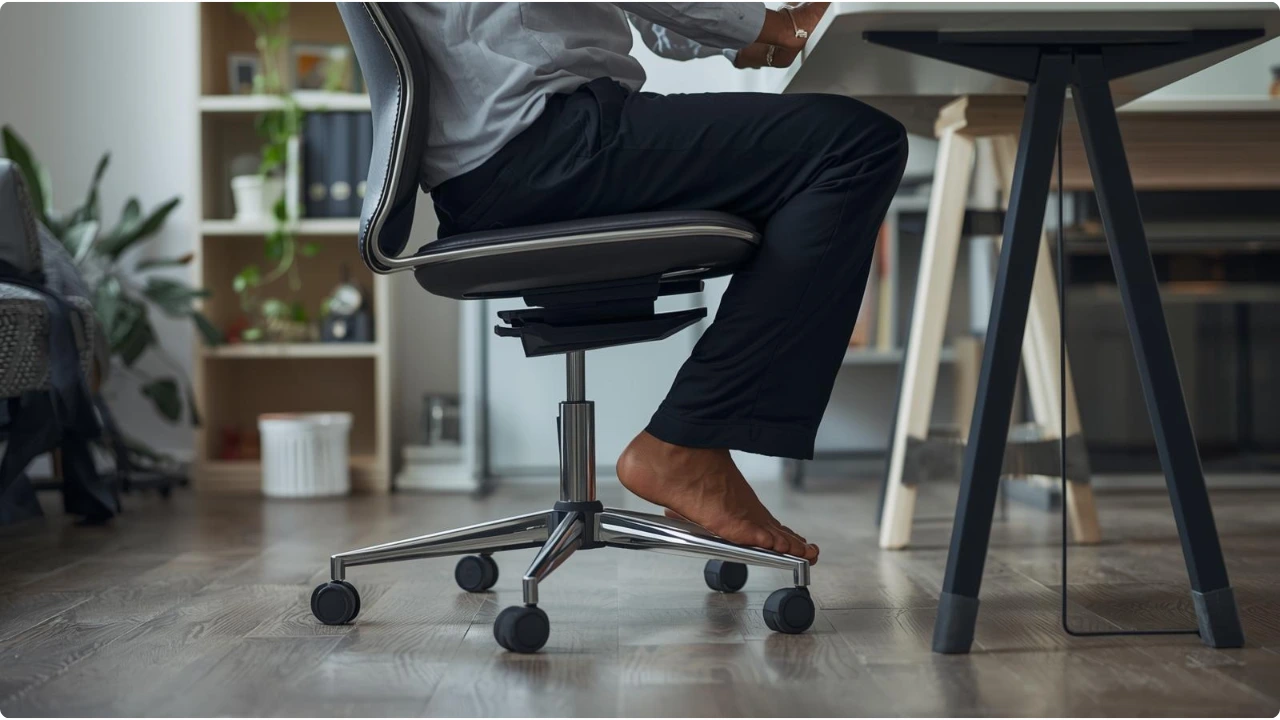
Lower back discomfort is common in desk setups where the chair, desk, and leg position don’t quite line up. A footrest can help — but not in the way people assume.

A footrest doesn’t treat back pain directly. What it can do is correct a mismatch lower down in your setup. When your feet don’t rest flat on the floor, pressure builds under the thighs and it becomes harder to sit back into the chair properly. Over time, that shift in position can increase strain around the lower back.
In those situations, supporting the feet can make sitting feel more stable. But if the issue is overall desk height, chair support, or long periods of static sitting, a footrest on its own won’t solve it.
When a Footrest Helps With Back Pain
Why Foot Position Affects Your Lower Back
When you sit at a desk, your lower body forms the base of your posture. If that base is unstable, the upper body has to compensate.
One common issue in home setups is raising the chair to match desk height. That often leaves the feet slightly off the floor or only touching at the toes. When that happens, more pressure sits under the thighs rather than being shared between the feet and the seat.
That pressure can subtly change pelvic position. Instead of staying neutral, the pelvis may tilt backwards as you slide forward to reach the floor. Once you lose contact with the chair’s backrest, lumbar support becomes less effective, and the lower back carries more of the load.
Even small shifts in leg angle can influence how the spine settles during long periods of sitting. Over time, static posture combined with uneven weight distribution can increase fatigue around the lower back.
A footrest works by restoring contact at the feet. With the feet supported, weight spreads more evenly through the lower body. That makes it easier to sit fully back in the chair and maintain a more neutral position through the hips and lower spine.
It doesn’t change the spine directly — it stabilises the base that supports it.
When a Footrest Is Worth Trying
A footrest makes sense when the rest of your setup is broadly workable but slightly mismatched in height.
For example:
- Your chair height feels correct for your desk, but your feet don’t sit flat.
- You notice your legs carrying more tension by the end of the day.
- You tend to shift forward in the seat to reach the floor comfortably.
In those situations, supporting the feet can stabilise your sitting position without changing the rest of the workstation.
If, however, the desk is fundamentally too high, the chair lacks proper back support, or you rarely sit back against the backrest, adjusting foot position alone won’t address the main issue.
A footrest works best as a small correction — not a structural fix.
When lower back discomfort builds during desk work, the most effective improvements usually involve the overall workstation and how often you move. An adjustable chair set up correctly will generally have a greater impact than any single accessory.
A footrest sits further down that scale. It becomes useful when the main issue is leg support rather than the entire setup.
Choosing the Right Type of footrest for Back Support
If foot position is contributing to discomfort, the type of footrest you use matters.
When the main issue is height mismatch — for example, your chair is raised to meet desk height and your feet no longer sit flat — a structured, height-adjustable platform offers the most controlled correction. In compact setups, an adjustable footrest designed for small desks allows you to fine-tune elevation without sacrificing legroom.
If you already sit at the correct height but feel stiffness during long sessions, a tilting or rocking design may be more appropriate. These models don’t significantly change elevation but encourage subtle ankle movement, which can help reduce static fatigue.
Where comfort is the priority rather than mechanical precision, softer or stackable/modular designs provide gentle support. They’re less structured than rigid platforms but can work well in smaller spaces when only moderate elevation is needed.
Choosing the right category first makes it easier to correct the issue without overcompensating. The goal isn’t to raise your feet as high as possible — it’s to restore balance within the space you’re working with.
If you’re unsure which type suits your setup, understanding the space under your desk and how much elevation you need makes the decision much easier.
How to Position a Footrest So It Supports Your Back
A footrest only helps if it’s positioned correctly within your existing setup. A few small adjustments can make the difference between added support and added strain.
- Set your seat position first.
Sit fully back in your chair with your lower back supported by the backrest. Adjust your chair height for your desk first, before introducing a footrest. - Match knee height to hip height.
Your knees should sit level with or slightly below your hips. If the footrest raises your knees noticeably higher, reduce the height. The goal is support, not excessive elevation. - Place it close enough to avoid reaching.
Your feet should rest naturally on the platform without extending your legs forward. Reaching for a footrest can pull you away from the backrest and reduce lumbar support. - Check desk clearance.
Make sure your knees aren’t pushed toward the underside of the desk once the footrest is in place. In smaller setups, crossbars or keyboard trays can limit usable space.
When positioned correctly, a footrest should make your sitting posture feel more stable — not higher, cramped, or forced.