
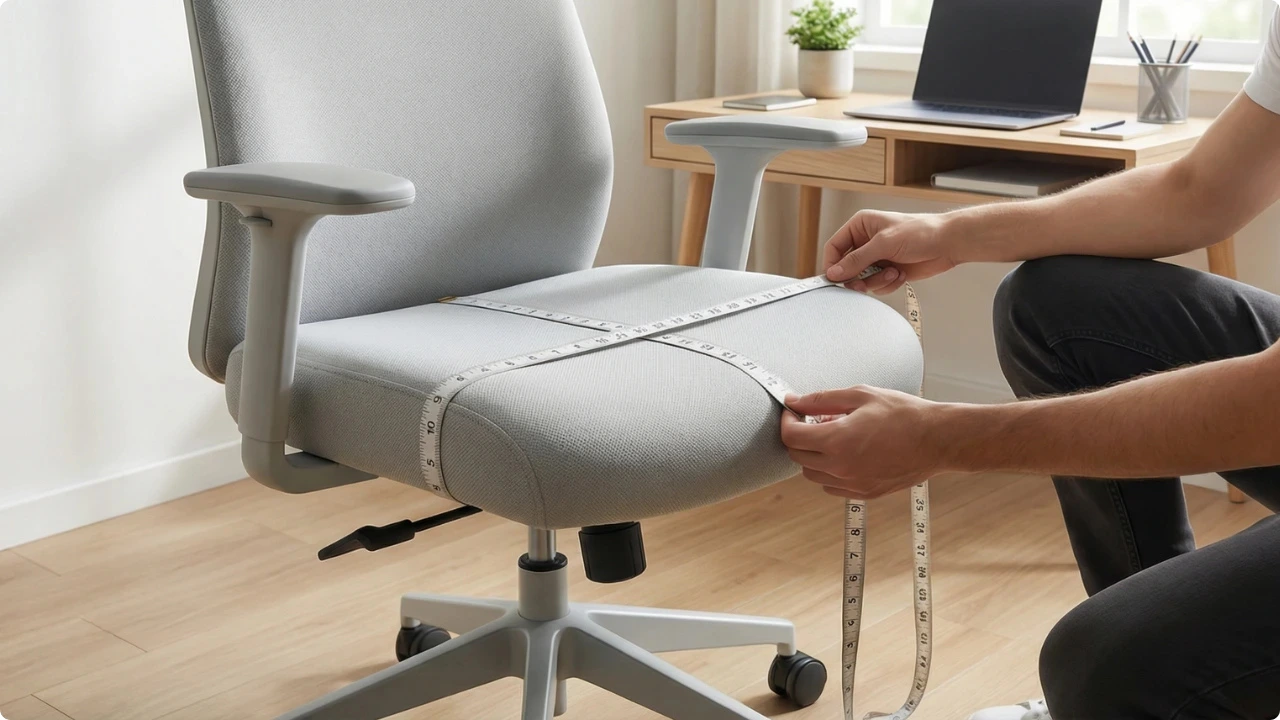
An office chair cushion can improve comfort, posture, and pressure relief — but only if it fits properly. The wrong size can raise you too high, press into your legs, or shift your alignment.

A cushion should improve comfort without disrupting your natural sitting position. Even small sizing mistakes can alter hip, knee, and lower-back alignment.
A Guide to Sizing for Office Chair Seat Cushions
How Sizing Affects the Functionality of Office Seat Cushions
Cushions change your sitting height and pressure distribution. That means size directly affects how your body aligns with your desk.
A common ergonomic guideline is to keep knees roughly at a 90–100° angle, elbows level with the keyboard, and shoulders relaxed.
Feet should remain supported — either on the floor or on a footrest.
If a cushion disrupts that position, it can create new problems.
Width & Depth Problems
- If a cushion is too narrow, you may perch on the edges. That reduces pressure relief and can affect balance.
- If it is too wide, it may hang over the sides of the seat. This can make it unstable.
- If it is too deep, it can press into the back of your knees. That may affect circulation and cause numbness.
The cushion should sit fully on the chair without overhanging the front edge.
Thickness Problems
- Thickness affects height more than width or depth.
- Too thin, and the cushion compresses fully — offering little relief.
- Too thick, and you sit noticeably higher. That can alter knee angle, reduce foot contact with the floor, and misalign elbow height with the desk.
Shape & Alignment Problems
- Coccyx cut-outs and wedge designs only work if your body aligns correctly with the cushion’s shape.
- If the cushion is too short or too long, the cut-out may not sit under your tailbone properly.
- Wedge cushions tilt the pelvis slightly forward, which can support a more neutral spine position when sized appropriately.
- But if the wedge is too thick for your desk setup, it may push your knees too high.
Coccyx cut-outs and wedges behave differently in compact setups, which is why choosing the right seat cushion for a small desk setup goes beyond size alone.
How to Measure Your Office Chair Seat
Use a tape measure and follow these steps:
- Measure seat width
Measure across the flat sitting area of the seat (left edge to right edge), not the armrests or outer frame. - Measure seat depth
Measure from the backrest to the front edge of the seat. - Check knee clearance
Sit back fully in your chair. There should be a small gap (about two finger widths) between the seat edge and the back of your knees. - Measure current sitting height
Sit normally. Check whether your feet are flat on the floor and your knees are level with or slightly below your hips. - Check desk and armrest height
Your elbows should be level with your desk surface and your shoulders relaxed.
These measurements help you choose a cushion that fits the chair — and your posture.
Standard Office Chair Cushion Sizes Explained
Width
- 16–18 inches: Usually suits compact task chairs.
- 18–20 inches: Common for standard office chairs.
- 20+ inches: For wider or executive-style seats.
Depth
- 15–17 inches: Standard fit for most chairs.
- 17–19 inches: For deeper executive-style seating.
Thickness
- 1–2 inches: Minimal height change. Light padding.
- 2–3 inches: Balanced support for most people.
- 3+ inches: More pressure relief, but noticeable height increase.
Choosing Thickness Based on Your Setup
Thickness should match your desk setup — not just how soft you want the seat to feel.
Standard Desk Height (Around 29–30 Inches)
- A 2–3 inch cushion often works well.
- It improves comfort without drastically raising elbow height.
Limited Clearance Desks
- If your desk is already close to your thighs, the thinnest low-profile office chair seat cushions can be as low as 3cm providing some support without elevation.
- This prevents knee compression and keeps armrests aligned with the desktop.
Already High Seating Position
- If your feet barely touch the floor now, avoid thick cushions.
- Your feet should remain flat on the floor or footrest.
- If they lift, it can place additional strain on the lower back.
What Happens If You Choose the Wrong Size?
- Incorrect sizing often becomes noticeable quickly.
- You may notice pressure behind the knees.
- Your knees may sit higher than your hips.
- Your feet may no longer rest flat on the floor.
- The cushion may slide forward during use.
A correctly sized cushion should feel stable and integrated with the chair.
Quick Size Checklist
Before buying:
- Measure seat width
- Measure seat depth
- Leave a small gap behind the knees
- Check desk and armrest height
- Choose thickness based on your current seat height
A properly sized office chair cushion should feel like part of the chair — not an extra layer sitting on top.