
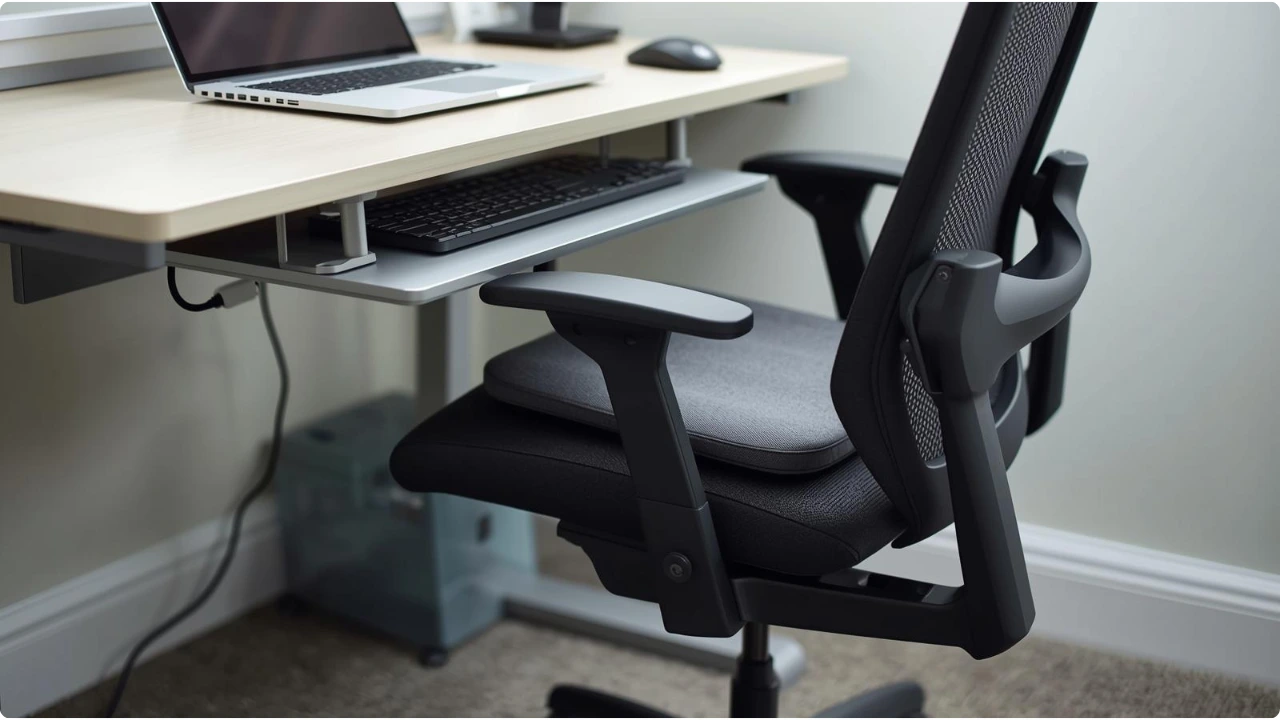
A seat cushion can solve the wrong problem just as easily as the right one. At a small desk, even a few centimetres of added height can change everything.
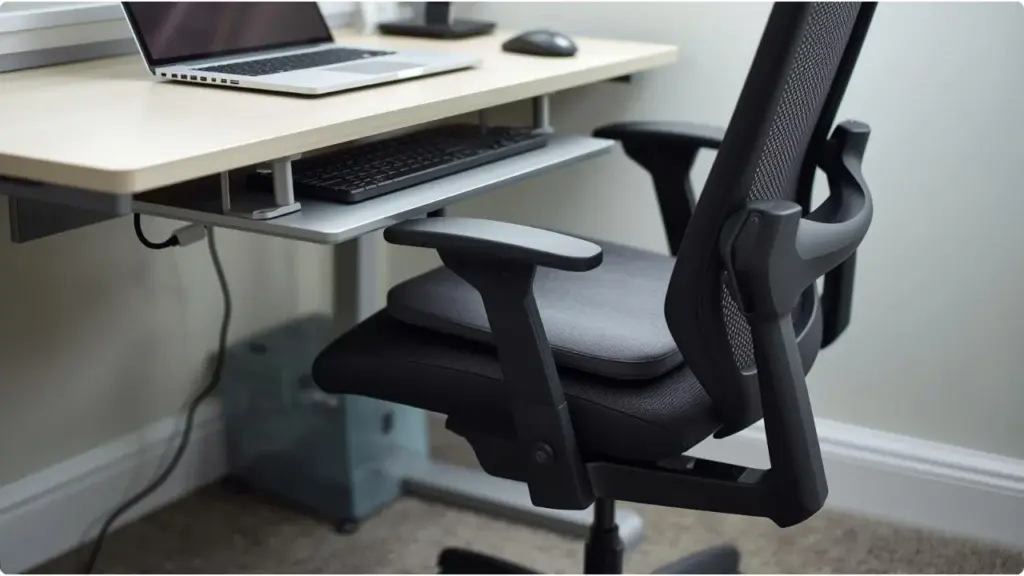
When desk height can’t be adjusted, comfort upgrades become more complicated. A thicker cushion might soften a firm chair, but it can also reduce knee clearance or alter your elbow position at the desk.
Choosing the right office chair seat cushion in a compact setup depends less on comfort alone and more on how it behaves under load — how much it compresses, how it changes seat angle, and how it affects your overall posture.
Finding the Office Chair Seat Cushion that’s Right for You
Know What You’re Actually Trying to Fix
Cushion choice depends on whether you’re correcting surface firmness, seated height, or pressure distribution.
General Comfort vs Targeted Pain Relief
A firm seat typically creates broad discomfort across the hips and thighs. Localised pain — such as tailbone pressure or radiating sciatic symptoms — suggests a more specific issue.
- Tailbone discomfort often responds better to a coccyx cut-out design that removes direct rear pressure.
- Nerve-related pain may require a contoured or medically focused cushion rather than a simple flat pad.
Persistent or worsening pain should be assessed by a healthcare professional rather than self-managed through seating adjustments alone.
Is Your Chair Too Low — or Just Too Hard?
This is where confusion often starts.
If your elbows already sit level with your desk at roughly a right angle, adding height may create misalignment rather than comfort. In that case, a thinner cushion is usually safer.
If your chair sits slightly low relative to the desk, a small lift — typically 2–3 cm effective height — can help restore alignment.
Advertised thickness doesn’t equal seated lift. Most foam and gel cushions compress under body weight, often by 30–50%. A 5 cm cushion may provide closer to 2–3 cm of effective lift in practice. Compression varies by user weight and foam density.
Gel structures tend to collapse more directly under load. Dense memory foam compresses more gradually and rebounds more slowly.
Consider the Geometry of a Small Desk Setup
Under a compact desk, space constraints aren’t limited to height alone. Depth, side clearance, and under-desk obstructions all affect how you sit and move.
Shallow desks positioned against a wall can reduce forward leg extension. Built-in drawers or keyboard trays limit upward clearance. PC towers, shelving, or storage units beneath the desk restrict lateral movement. Even cable trays can interfere with foot placement.
When movement range is already constrained, adding a cushion changes more than seat height. It can alter how easily you reposition your legs, shift your weight, or use an appropriate footrest comfortably.
In these environments, cushions that compress predictably and maintain a stable profile tend to integrate more cleanly into the setup.
How Material Choice Affects Function
Material influences how a cushion feels in use, how stable it remains, and how it performs over long sessions.
Memory Foam
Memory foam conforms to body shape, distributing pressure across a wider surface area. For desk use, medium-firm foam tends to provide better support than very soft variants.
It can retain heat and may feel firmer in colder rooms. Over extended sitting, it gradually settles before returning to shape once weight is removed.
Gel / Honeycomb
Gel structures prioritise airflow. They typically feel firmer at the surface and allow more ventilation than traditional foam.
Because the material structure collapses vertically rather than slowly contouring, it often feels flatter and more stable during subtle movements.
Low-Density Foam
Very soft foam can feel comfortable at first but often loses resilience quickly. Over time, it may compress permanently and provide less meaningful support.
In compact desk setups, durability and consistent support matter more than initial plushness.
Shape Influences Position More Than Material
While material affects feel, shape determines how your weight is distributed and how your pelvis sits on the chair.
Flat Cushions
Flat pads provide uniform lift across the seat. They maintain your existing sitting posture with minimal structural change, making them the most predictable option when you don’t want to alter alignment significantly.
Because pressure remains evenly distributed, they tend to feel stable during small position shifts.
Coccyx Cut-Out Designs
Cushions with a rear cut-out remove direct pressure from the tailbone without dramatically changing overall seat height.
They slightly redistribute load toward the thighs and hips rather than the centre rear of the seat. For users with localised tailbone discomfort, this can reduce pressure without introducing major positional changes.
Wedge Cushions
Wedge cushions raise the rear of the seat more than the front, subtly encouraging the hips to sit higher than the knees.
This changes pelvic angle rather than simply adding padding. In fixed-height desk setups, that structural shift requires adequate rear and under-desk clearance.
Because weight shifts forward, they can also alter how your feet contact the floor or a footrest.
Other specialist shapes — such as donut-style or inflatable dynamic cushions — are typically intended for medical or active sitting contexts rather than long, fixed desk sessions.
Consider How the Cushion Integrates With Your Chair
Even the right material and shape can feel wrong if the cushion doesn’t sit securely on the chair base.
Flat seat pans are generally more compatible with standalone cushions. Deeply contoured or bucket-style chairs can cause flat cushions to tilt or shift, especially during movement.
Cushions that overhang the seat edge may compress unevenly and feel unstable. A secure fit — with a non-slip base or light strapping where needed — reduces micro-movements throughout the day.
In small desk setups, stability matters. If a cushion slides every time you adjust position, it becomes a distraction rather than an upgrade.
What a Cushion Can’t Fix
A seat cushion modifies the surface you sit on. It doesn’t change the underlying geometry of your desk setup.
If your chair height is fundamentally misaligned with the desk, adding padding won’t correct that relationship. If the desk itself is too high relative to your body, raising your seat further can make alignment worse rather than better.
Likewise, a severely worn-out chair with collapsed internal padding may require replacement rather than reinforcement. Cushions improve surface comfort and pressure distribution, but they don’t redesign the structure beneath them.
In compact workstations especially, comfort upgrades work best when basic height and layout are already reasonably aligned.
Narrowing the Choice
Most office chair seat cushions fall into one of three functional categories: flat support, pressure-relief designs, or angle-adjusting wedges — each behaving differently in compact desk setups.
If your goal is subtle comfort without meaningfully altering seated height, a thin flat cushion is usually the most predictable option.
If localised tailbone pressure is the issue, a rear cut-out design can redistribute load without introducing major positional change.
Wedge cushions influence seat angle more noticeably and require sufficient space to accommodate that shift.
Once you know whether you’re adjusting surface comfort, pressure distribution, or pelvic angle, the remaining decision becomes simpler.