
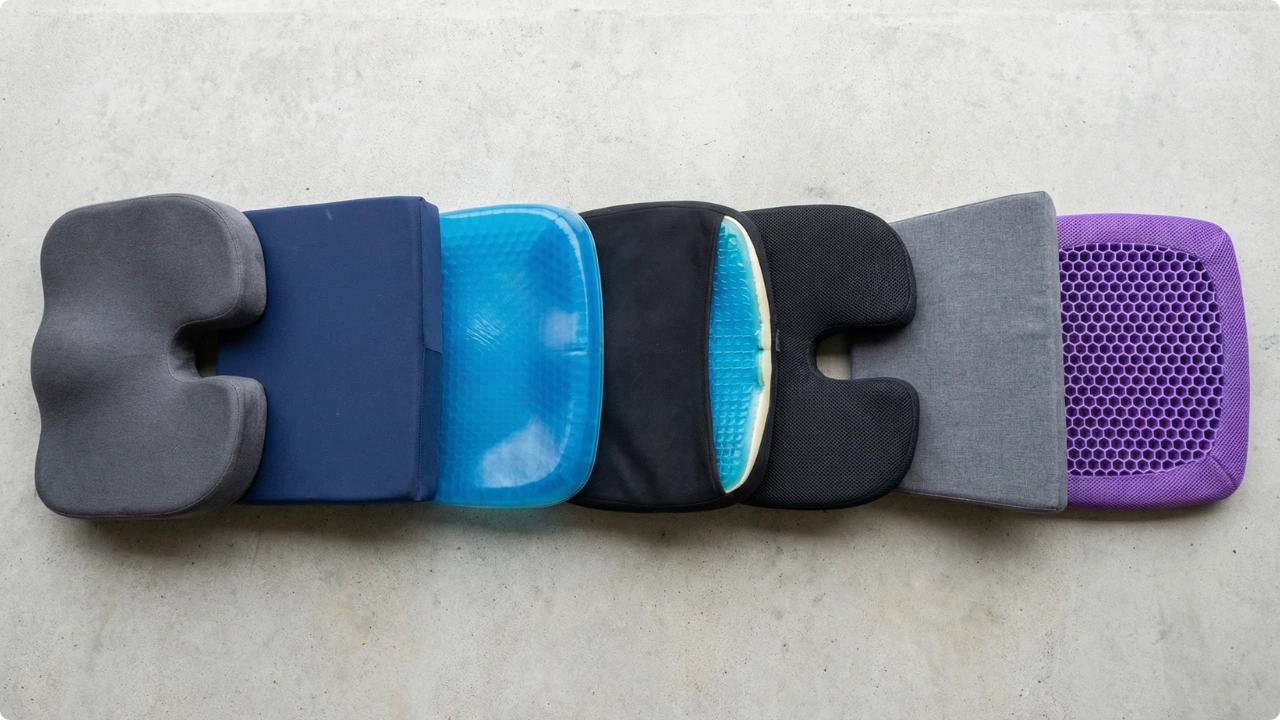
Different cushion types compress, tilt and distribute pressure in different ways. Knowing how they function helps you filter out what won’t suit your chair.
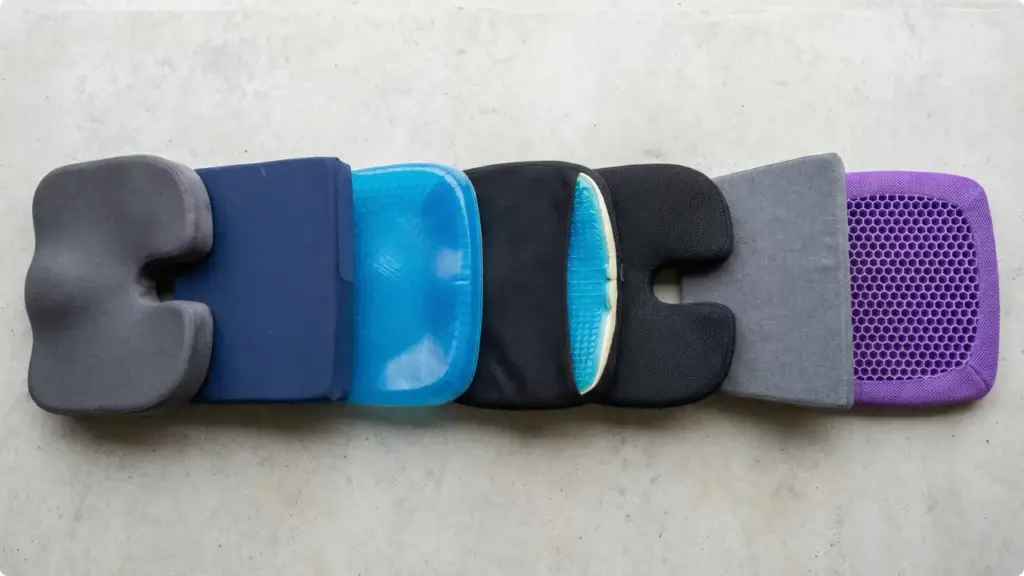
There’s no shortage of office chair seat cushions, and many look similar at first glance. The difference only becomes obvious once you sit down.
Two things separate them: what the cushion is made of, which decides how it feels and how warm it gets, and what shape it’s cut into, which decides what it changes about the way you sit. You’re choosing on both axes, and they’re independent — a coccyx cushion is still made of foam or gel, and a wedge is still a wedge whichever material it’s cut from.
On this page
The Quick Comparison
Office chair seat cushions are generally made with one of four materials. Those are used for a few types or shapes of seat cushions. The best fit is found by matching the material you’d find comfortable to the shape/structure type that supports how you sit on the chair.
Materials
| Material | Feel | Heat | Height Impact | Best when |
| Memory Foam | Slow sink, contours to hips and thighs | Retains | Raises noticeably | Padding is worn or uneven and pressure relief is the priority |
| High-density foam | Firm, fast rebound, no sink | Neutral | Lower profile | The chair needs reinforcing rather than more cushioning |
| Gel | Firmer, springy | Cooler | Predictable | Memory foam feels too warm or too soft |
| Gel–memory foam hybrid | Shallow sink, slightly firmer surface | Retains less | Raises, depending on thickness | You want contouring but found pure memory foam too warm |
Shapes and Structures
| Type | What it changes | Height impact | Best when | Main risk |
| Coccyx (U-shaped) | Suspends the tailbone instead of padding it | Raises, depending on thickness | Discomfort at the base of the spine | Wrong placement, or foam soft enough to close the gap |
| Wedge / posture | Tilts the pelvis forward, hips above knees | Raises at the rear | The chair has no built-in seat tilt | Lost desk clearance; sliding on smooth upholstery |
| Gel grid / polymer grid | Distributes pressure without contouring | Consistent | You want relief without sinking | Edge collapse on thin versions |
Materials: What It’s Made Of
These four are alternatives to each other. Every cushion is made of one of them, including the shapes further down.
1. Memory Foam (Viscoelastic)
Memory foam is the reference point everything else gets defined against. It’s a viscoelastic polyurethane foam that softens under body heat and pressure, so it contours around your hips and thighs rather than pushing straight back. Sit down and it compresses gradually; shift position and it takes a moment to return.
The heat is a structural consequence, not a manufacturing flaw. A solid viscoelastic core has no airflow path through it, so warmth builds where you’re sitting and stays there.
Two failure modes are worth knowing. Low-density versions feel plush on day one and lose firmness within months — the “hugging” feel goes shallow and stays that way. And thick models raise you enough to matter, which is the seat height problem covered further down.
2. High-Density Foam (Standard Polyurethane Foam)
High-density foam is memory foam’s opposite in feel: it compresses quickly, rebounds almost immediately, and never gives you the sinking sensation. It doesn’t rely on body heat to soften, so its structure stays uniform and pressure spreads across the surface rather than concentrating into a moulded shape.
The label is where people can be misled. Density is a measure of weight per cubic metre — it describes durability, not softness or support. “Orthopedic” and “firm support” are marketing terms layered on top of a spec that says only how well the foam resists permanent dents. Well-made high-density foam does resist them better than most softer foams.
The failure mode is straightforward: too firm for your body weight and you swap general discomfort for concentrated pressure on the sit bones or under the thighs.
3. Gel
Gel is firmer and springier than either foam. It compresses slightly, rebounds quickly, and gives you very little of the deep contour — support comes from elastic compression within the gel itself rather than from heat softening it.
It runs cooler for a mechanical reason: gel conducts heat away from the contact surface, where dense foam insulates it. That’s a real difference, not a marketing claim, though it’s a matter of degree rather than a cold seat.
Thickness matters here more than with any other material. A thin gel pad on a hard chair will bottom out — you compress through the gel to the seat underneath and lose the benefit entirely. Check for a supportive base layer, and a non-slip underside if your upholstery is smooth.
4. Gel–Memory Foam Hybrid
The honest description of a hybrid is memory foam with a gel layer on top. The foam base still does the contouring and pressure distribution; the gel adds some airflow and takes the edge off the heat. You’ll notice less deep sink than pure memory foam and a slightly firmer, more responsive surface.
“Best of both” is the pitch, and it oversells. There’s still a significant amount of foam under you, and over a long session it still retains warmth — less than a solid memory foam cushion, but more than gel or grid. The ratio between the two layers and the quality of each decides how the cushion feels when in use.
Shapes and Structures: What It’s Cut Into
These aren’t alternatives to the materials above — they’re made from them. The shape decides what changes about your sitting position.
5. Coccyx (U-Shaped) Cushions
The cut-out at the rear edge doesn’t pad the tailbone. It removes the material under it, so the coccyx sits slightly suspended while your weight redistributes onto the thighs and sit bones. That’s the whole mechanism, and it explains both ways the design fails.
If the foam is too soft, it flattens under load and the gap closes. The cushion still looks like a coccyx cushion, but you’re sitting on the seat again and the off-loading effect is gone. Firmness has to match your body weight for the cut-out to stay open.
Placement is the other one, and it’s the part people rarely consider. The cut-out has to align with the tailbone. Sit too far forward or too far back and you’re sitting on a cushion with a hole in the wrong place — no relief where you need it, and possibly a new pressure edge where you don’t. Worth checking every time you sit down, particularly if you’re moving the cushion between an office chair and a car seat, which is a common reason for buying one.
Too firm, and the redistributed weight creates its own pressure points along the thighs.
6. Wedge / Posture Cushions
A wedge doesn’t change your seat — it changes your body. The sloped profile, thicker at the back and thinner at the front, sits your hips above your knees and tilts the pelvis forward. Compared with a flat surface, that tilt can encourage a more neutral spinal alignment, which is why they’re sold as posture-correcting cushions.
The tilt does all the work, so it’s the angle and the firmness that matters more than what the product descriptions of these. Lower-quality foam compresses unevenly over time, and the slope can shallow out.
Two failure modes, both about the angle rather than the padding. A steep wedge on smooth upholstery pushes you forward — you spend the day bracing against a slide instead of sitting. And because the rear is raised, the wedge eats into your desk clearance: knee height rises, thigh space narrows, and the chair may not tuck under the way it did.
On a lower desk this is the deciding factor, not comfort. If you’re working in a compact setup, matching the wedge height and angle to your desk before you buy is the difference between a useful cushion and one that makes the day worse.
7. Gel Grid / Polymer Grid Cushions
A grid cushion is a structure rather than a material — a hyper-elastic polymer arranged in an open honeycomb of interconnected cells. There’s no solid core. Individual cells collapse under the areas carrying most pressure while the cells around them stay standing.
That local collapse is why it distributes pressure evenly without contouring: it isn’t moulding to you, it’s failing selectively underneath you. And because the cells are open, air moves through the structure — the one design here that has a genuine path for heat to escape rather than just a material that conducts it away. The feel is springy or slightly firm, never plush.
The failure mode is edge collapse. Thin grid cushions on a hard chair have nothing to brace against at the perimeter, so the outer cells fold and you lose support exactly where your thighs sit. A supportive base underneath solves it. A non-slip underside handles smooth upholstery.
Seat Height: The Thing Every Cushion Changes
Every seat cushion, regardless of thickness, adds height. That sounds obvious, and it’s the most commonly ignored fact in the category.
Add 5cm under you and your hips rise 5cm. Your armrests don’t. Your desk doesn’t. So the armrests may then sit too low relative to your shoulders, and your forearms either hang or lift; the desk sits closer to your torso than it did; and your knees come up. The fix for a sore seat becomes a sore shoulder in about a fortnight, and because the two problems arrive at different times, most people never connect them.
This is why thickness is a specification and not a comfort rating. Before buying, measure the gap you actually have: seat to armrest, seat to underside of desk. Then check the cushion’s compressed height, not its listed height — foam-based cushions lose a meaningful fraction of their depth under load, and the listed figure is the uncompressed one.
If your setup is already close to its limits, that measurement will rule out most of the thick foam options before you start. Low-profile office chair seat cushions exist for exactly this reason, and in a compact setup they’re the safest starting point.
Match the Type to the Way You Sit
Each type changes support, height and stability in different ways. Once you understand how the material and the shape affect your sitting position, it becomes easier to filter out what won’t suit you.
The decision splits cleanly along the two axes. Choose the material for how you want it to feel — how much you sink, how warm it’ll feel under you when you’re sat on it for hours, and how much firmness your weight needs. Choose the shape for what you want it to change — nothing, tailbone pressure, or your pelvic angle.
The right type won’t just feel comfortable at first. It will support how you sit, how your chair supports that, and how your desk is set up.