
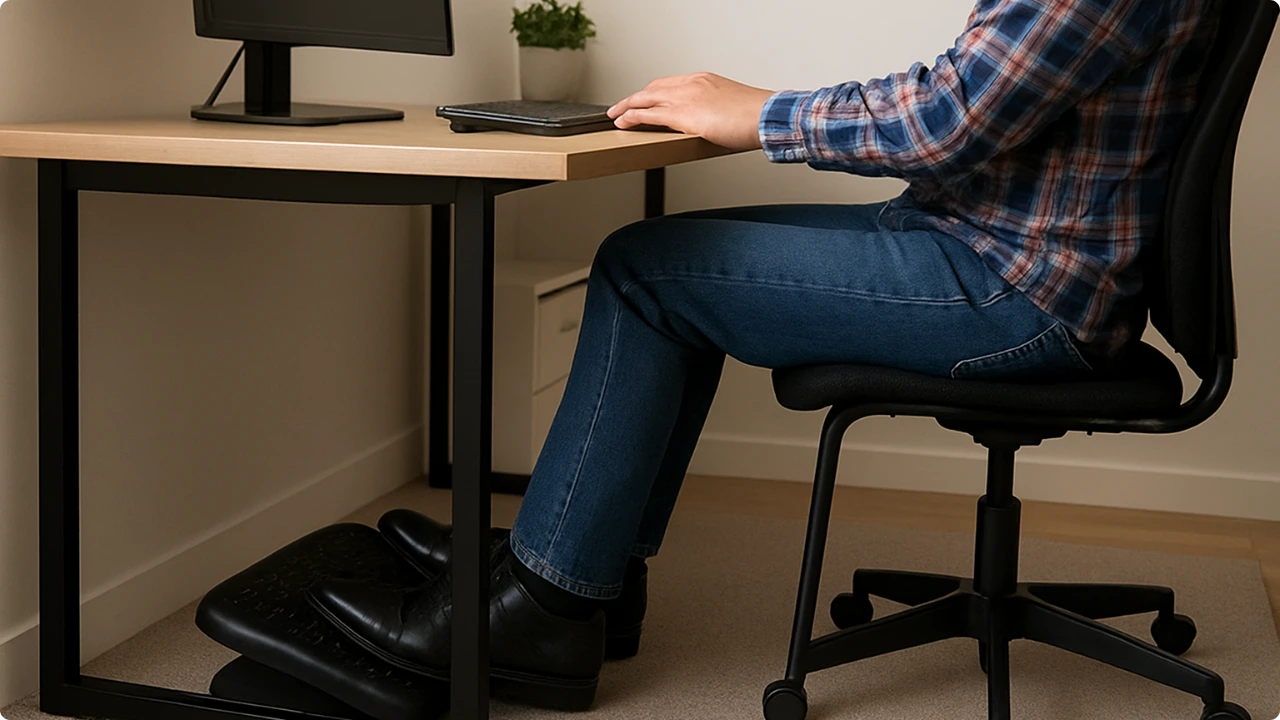
Compact desks are common in spare rooms, shared areas, and temporary workspaces where space is limited. Small footrests are available in several designs. Identifying the appropriate type first makes it easier to select one that fits your setup.
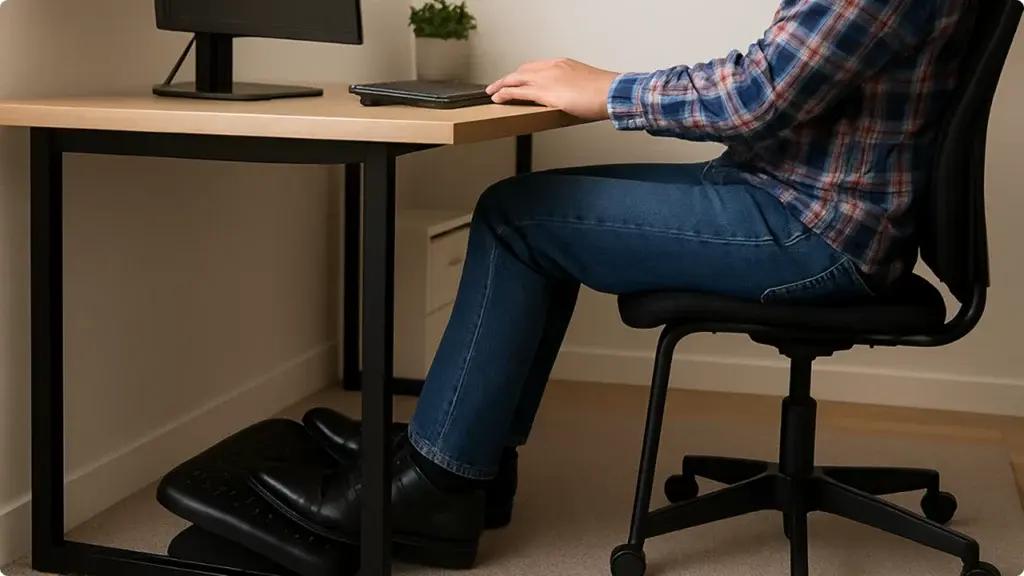
Small desks limit the space available under the work surface. That affects which type of footrest will fit comfortably without reducing legroom.
Some designs are too tall for low-clearance desks. Others take up too much depth, preventing you from sitting close enough to work properly. In compact setups, size and angle matter more than features.
Choosing the right option comes down to height, footprint, and adjustability.
Under-Desk Footrest Designs for Compact Workspaces
What Makes a Footrest Suitable for Compact Desks and Tables?
Under smaller desks, clearance and positioning matter more than added features. A suitable footrest must fit within limited space while allowing you to sit in a balanced position.
Low Overall Height
In many compact setups, the chair is raised to align wrists with the keyboard or desk surface. When that happens, feet may no longer rest flat on the floor.
Some desks also include pull-out keyboard trays, storage panels, or crossbars beneath the surface, which can reduce usable clearance even if overall desk height appears sufficient.
A low-profile platform restores contact without pushing the knees toward the underside of the desk. For small desks with fixed height, excessive elevation can reduce clearance and restrict movement.
Shallow Depth (and Stable Footprint)
Small desks often sit against walls or in alcoves, which limits how far the chair can move back. A deep footrest can prevent the chair from tucking in properly.
Slimmer designs reduce front-to-back obstruction and allow more usable legroom. Footprint stability also matters. Chairs with four legs or sled bases can sit partially over a compact platform, while chairs with wide circular bases on castors may limit how close the chair can move regardless of footrest size.
Adjustable Angle
Not all desk and chair combinations align perfectly. When desk height is fixed, slight tilt adjustment can help maintain a neutral lower-leg position without increasing overall height.
A model with controlled angle adjustment allows fine-tuning without introducing bulk. This is particularly useful in compact workstations where vertical space is limited but minor correction is needed.
Suitable Footrest Types for Small Desks
The following types tend to work best where clearance and depth are limited.
Low-Profile Angled Platforms
These models provide a slight fixed elevation, usually within a 3–6 cm range. Their shallow depth and minimal height make them suitable for desks with limited underside clearance.
They are typically sufficient where only minor correction is needed, such as when feet are slightly lifted after raising a chair. Because they do not add significant bulk, they allow most standard chairs to remain positioned close to the desk.
Compact Adjustable Tilt Models
These combine a modest footprint with controlled height or angle adjustment. Tilt ranges commonly fall between 12° and 18°, allowing more precise positioning without increasing overall depth.
Where a chair has been raised to match desk height and feet no longer rest flat, a height-adjustable footrest for small desks allows correction without introducing a tall or intrusive platform.
In compact setups, this type offers the most flexibility while still fitting within restricted legroom.
Small Foam Wedge Footrests
High-density foam wedges provide moderate elevation with a softer surface. Many are designed with detachable layers or reversible shapes that allow slight variation in height.
Their lighter weight makes them easy to reposition in shallow spaces. However, because foam can compress over time, they provide less structural support than rigid platforms.
For desks with adequate width but limited depth, a compact wedge can offer elevation without adding mechanical components.
Slim Rocking Footrests
Rocking designs encourage subtle ankle movement rather than vertical lift. They typically require slightly more front-to-back space to accommodate the rocking arc.
In very shallow desks, depth should be measured carefully before choosing this type. Where space allows, they provide movement support without increasing overall height.
Types That Are Usually Unsuitable for Tiny Desks
Some designs are better suited to larger workstations. In compact setups, they may reduce clearance or limit how closely you can position your chair.
- Large multi-tier plastic platforms
Often deeper and taller than compact desks allow. Their footprint can prevent chairs from tucking in fully. - Full leg rests or extended supports
Designed to elevate calves or thighs rather than provide basic foot contact. These require more length and are typically used in reclined or medical-style setups. - High-elevation configurations of modular footrests
Stackable or multi-block designs can provide significant height. In their tallest configuration, they may not fit beneath a small desk. However, some can be used at a lower setting during desk work and expanded for use away from the desk.
As with other categories, suitability depends on usable clearance rather than the product label alone.
How to Choose Between the Suitable Types
In compact workstations, the key decision is usually the design before looking at the exact dimensions. Filter by the type that’s suitable and then look at sizes for small under-desk footrests to fit.
- Low-profile platforms suit setups where only minor elevation is needed.
- Adjustable tilt models provide greater correction where chair height has been raised.
- Foam wedges offer moderate lift with a softer surface, while slim rocking designs prioritise movement over vertical adjustment.
Once the appropriate type has been identified, checking measurements becomes straightforward. Small desks naturally limit which designs will function comfortably, so selecting the correct category first simplifies the process.